WrestleQuest Review – Questionable Booking

WrestleQuest has been my fantasy premise since I was a kid. WrestleQuest is a video game which combines classics such as ChronoTrigger and Final Fantasy VI with an exciting sports element. Please sign me up. Sign me up.
WrestleQuest takes place in an action figure-filled toybox. You can combine the fun of WrestleQuest with the fantasy of Toy StoryWWE shows are known for their zaniness, world-building and wrestler-centric content. Ultimate Muscle, that’s a rough idea of WrestleQuest’s vibe. My favorite part is the presentational eye candy. Bright, colorful artwork, silly character designs and amazing animations lend the game an enjoyable personality that is both a celebration and satire of the sport.
Copious references abound for enthusiasts, including appearances from real-life stars like Jake “The Snake” Roberts, Diamond Dallas Page, Jeff Jarrett, and even personalities like Conrad Thompson. Even though it is nice to run into a familiar name, there are some instances where the cameos seem forced. It feels strange to run into Adi Shankar, a filmmaker and YouTuber. They are included just for the sake that there is a notable wrestler. Billboards in-game promoting real-life podcasts and platforms for wrestling also feel more like advertisements rather than fun references. They clash with the fantastical environment.
As Randy “Muchacho Man” Santos, essentially a Randy Savage tribute performer, you’re on a quest to become the biggest star in the toy box. Since he fully believes pro wrestling is legit (while everyone else knows it’s scripted), he also wants to stop a powerful promoter from turning it into pure entertainment. He visits many different regions that are themed around a certain promotion or style. One region highlights ECW-style hardcore wrestling, while another parodies Canada’s Stampede Wrestling of yesteryear. Some locales break the convention, like a futuristic sci fi world. They feel generic.
Along the way, you’ll recruit several allies, with parties regularly splitting off into their own separate stories. Expect to jump between Muchacho Man’s quest to a tale of a Hart Foundation-esque team’s climb to stardom to the story of a street-wise thug hoping to win the affection of a Transformer-style robot he just met, among other threads. Despite smiling at some references and nods, I didn’t find any of the characters interesting or engaging. The writing isn’t very funny, often relying on surface-level recognition of references. It’s not just that the overall story is flat, but it can also be confusing to follow because of how often you jump between stories. You’ll go from exploring a jungle with one group to searching for a wrestler’s lost item in a cemetery with another party to stealing cars in a crime-ridden city with yet another grouping. The haphazard pacing of these jumps is so frequent that they cripple the narrative momentum for any storyline.
Players execute their commands by pressing buttons at specific times and using QTE style mechanics. Hype is a gauge that builds when you perform well. This encourages spectators to support your team and give bonuses such as mana regeneration or damage boosts. Conversely, taking a beating swings Hype in your opponent’s favor, stacking the deck against you. The addition of managers and tag teams can give you additional benefits. In a neat twist, downed enemy wrestlers must be pinned, with the familiar “stop the needle” pinfall minigame feeling more appropriate here than in a simulation game (though failing this revives foes with some HP)
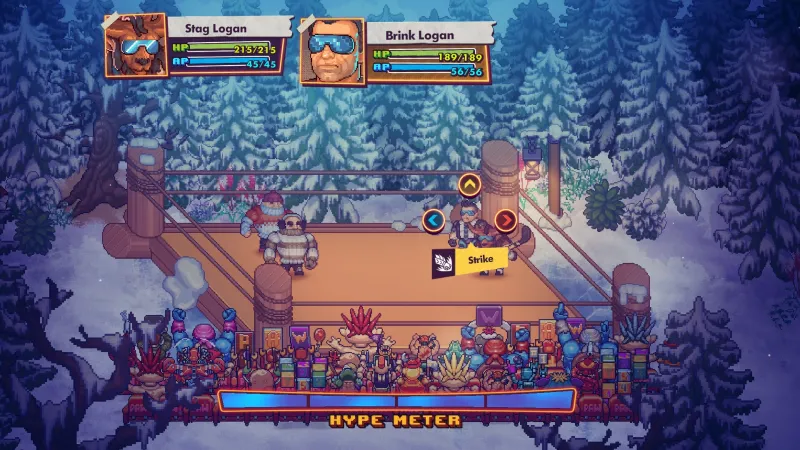
These are cool ideas that incorporate the spirit of a wrestling match while rewarding skillful play and an evolving challenge – in theory, at least. The gameplay itself is good, but the level of difficulty can be inconsistent. Sometimes, I’d breeze through battles only to suddenly hit rough patches where I’d barely survive a fight. The latter becomes a nightmare since you can’t flee battles (or quit/restart them), so you either have to win a fight you’re not ready for or die, reload a save, and potentially retrace quite a few steps due to the game’s questionable auto-checkpointing. You also can’t skip cutscenes, making replaying bigger encounters even more of a chore. Battles are often either repetitive, boring or a war of attrition.
Some battles require you to achieve a certain number of objectives. This is often done to your own detriment. Taking a cue from wrestling’s scripted nature, sometimes you must let yourself get beat up, release foes from pinfalls, or lose Hype to “win” an encounter. However, this puts you at the mercy of the opponent, who doesn’t always hold their end of the bargain as promptly as you would like. Intentionally losing Hype is the worst since almost everything you do adds to the meter, and there’s no “pass” option, so simply playing works against you. It’s impossible to finish a turn and not gain Hype. You can only do this by using an item. Then, pray that your opponent kills you before you waste all your healing items. I hated these types of battles because the game simply doesn’t allow you to throw fights as effortlessly as it needs to, and they just aren’t fun.
Party management feels antiquated since new allies join the group at Level 1 instead of scaling to the group’s average level. There’s also no shared experience gain, so you’ll have to throw a jobber alongside your main eventers to get them up to snuff, which basically turns them into fragile punching bags in battle. To avoid the headache of changing crews, I would often stick to a core group. This worked for me most of time. However, the game often forces you into unexpected situations where you’re stuck with a group of losers against a powerful foe, and you don’t always have the immediate freedom to prep beforehand.
Some tight spaces force you to fight, even though it is possible to see your enemies and sneak past them. Prepping for tough bouts meant backtracking to town for supplies, but locating the right stores, or anything for that matter, is a hassle since there’s no readily accessible map. There are no other options for guidance than the vague minimap, which only has compass points. It is easy to become lost when you follow what you believe to be the correct path only to find yourself in dead ends. Although it’s acceptable to do so on your first time in a new area, the backtracking process is tedious. WrestleQuest admirably tries to mix up exploration with various puzzles, like locating missing children or collecting clues to solve a murder mystery, but these generally don’t make much impression.
The limited number of save slots also makes it difficult to keep track of your progress. That’s not enough in a big RPG that regularly forces you into unfavorable party lineups and situations you may not be ready for. Saving yourself into a corner is frighteningly easy since you’re so boxed into hard battles that you’ll often want to save after even marginally difficult fights or lengthy segments between towns. Other times, you’ll be in situations where you can’t explore or grind and have to immediately enter a tough fight that, again, you weren’t anticipating and don’t have a save file set in a more explorable scenario.
WrestleQuest is a game that I loved, but it’s only for the patient and fans who can fireman them through. The imaginative ideas are slashed to death by the thousand, which keeps Muchacho and his team from competing for world titles. The game has cool ideas; it just needs more refinement and a serious reexamination of certain systems before it’s ready for the big time
#WrestleQuest #Review #Questionable #Booking