Tron: Identity Review – Grid-Based Decision-Making
We should all support the idea of taking established fictional worlds into new directions. Unfortunately, too many licensed games stick to the same characters and scenarios. This prevents them from growing. With Tron: Identity, Bithell Games takes the venerable Tron franchise and tries something entirely different – a visual novel with a light touch of puzzle gameplay. It’s worth a little excitement just for the novelty. This bite-sized film, while it makes a valiant effort to be innovative, falls short on some important fronts.
Tron: Identity can be compared to classic noir stories, as the investigator lives in a computer and wears a disk that contains his memories. He is also constantly surrounded with pulsing lights. The entire story unfolds within an extensive repository of information on “the Grid,” and it’s up to you to solve the mystery of a strange explosion and possible theft that occurred there. Along the way, you meet a handful of other characters, or “Programs” in the vernacular, and make choices that will affect how each feels about you and how receptive they might be to your inquiry. Written text is placed below images of characters and locations within the Repository.
It’s nice to have a limited story and a tight focus. But I can’t say I ever felt like I was solving a mystery. The information came to me at random intervals but I didn’t feel like a detective piecing everything together. The big picture was revealed, but it didn’t feel like the satisfying “click” of all the pieces finally fitting together. It felt more as if a plot twist had been revealed.
The dialogue and written descriptions help bring the images to life and add nuance. I enjoyed Bithell’s distinct take on the Tron world and the places the developer found to add new twists to that established fiction. Also, I liked the decision trees that allow players to customize their narratives, possibly even using different characters.
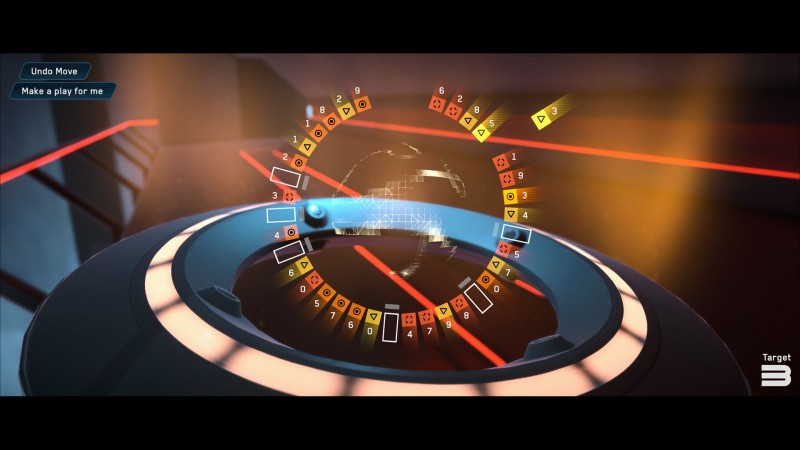
My character can help to clear and clarify the character memory that recent events inexplicably have damaged. This repair is a strange puzzle of matching cards and numbers into specific patterns. Over the course of a few hours, players will repeat different variations on this puzzle. The mechanic was not frustrating to me, but I did find it difficult to wrap up the game. Trial and error is usually the most effective way to do so. On a subsequent playthrough to explore different storytelling paths, I was happy to pause and skip the puzzles entirely – an option that was wise to include, based on my experience.
In its short playtime, Tron: Identity touches on some heavy themes. Issues of fate, the meaning of memory, and purpose in the face of extinction – all of these and more are explored, primarily in connection with the game’s subtitle: identity. By the end, no matter your choices, the game doesn’t seek to offer any particular conclusive statements on those topics. The game is fun because it’s interesting to see how different characters deal with these problems during an emergency.
While I applaud Tron: Identity’s unique structure, I never found myself drawn in and engrossed in the unfolding story. The setting is a great addition to fans of the Tron Universe. But even with some interesting ideas, I was ultimately a User who couldn’t manage to marshal a lot of interest in these Programs and their problems.
#Tron #Identity #Review #GridBased #DecisionMaking