Pentiment Review – Quill Power
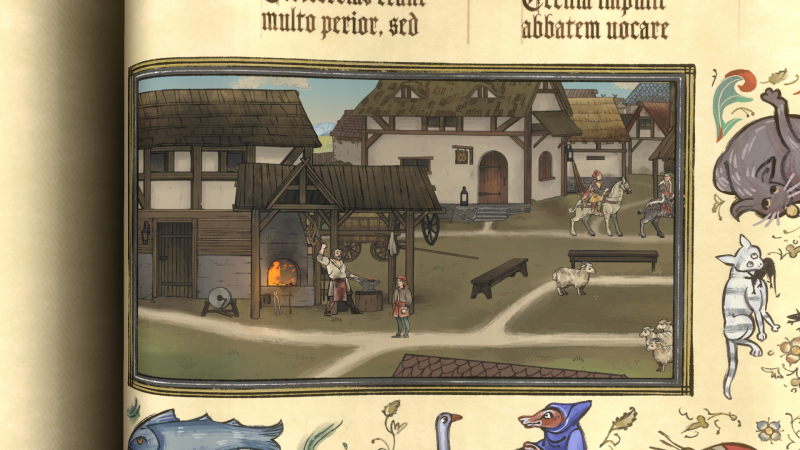
Stories that combine gameplay, narrative and art are the most successful in games. Pentiment, the latest from Obsidian Entertainment, is a perfect example of this, telling a deep, complex story about religion, truth, and history in the form of a book, which the player experiences as it’s being written. Despite a few sections with inconsistent pacing, it’s a must-play for fans of adventure games.
Pentiment is the tale of Andreas Maler, a traveling artist, and the time he spent in Tassing in 1518. It’s a fictional village in the country of the Holy Roman Empire. While Andreas’ regular routine has him working on his masterpiece or making copies of one of the local abbey’s manuscripts, he quickly becomes wrapped up in a series of local mysteries he tasks himself with solving.
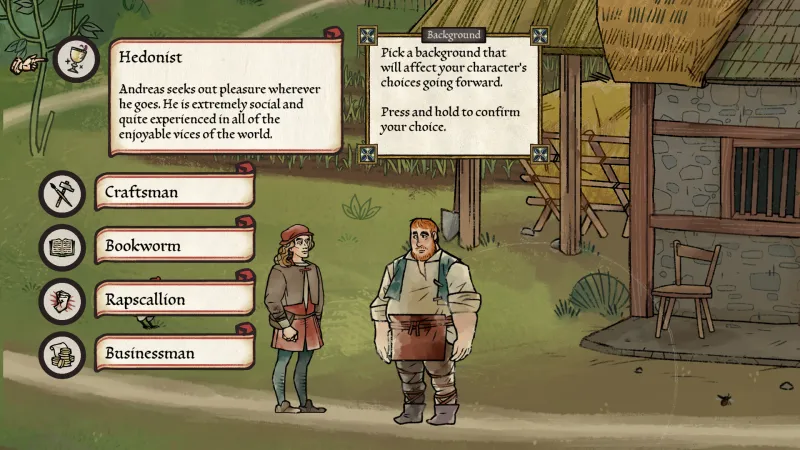
Andreas is customizable with different personality traits and backgrounds to allow for different dialog options. While my Andreas was a scholar of theology with a history in hedonism and another could have been a lawyer who spent most of his time outdoors, he might not have had that background. The dialogue options these different backgrounds unlock aren’t usually anything substantial, but it’s nice to have a sense of control over your conversations since they make up the vast majority of the game.
Pentiment’s story is told in three acts. Two of these act involve the investigation into murders. This is where Pentiment’s best moments are, thanks to both the big stakes as well as the massive accusations. There’s only so much time to solve the case, but significant actions like eating meals with suspects or searching abandoned ruins will push you through the day, meaning you only have a limited number of chances to chase down the truth. Although I wanted to know as many details as possible, there is more information than I have time to pursue. Pentiment is a different kind of murder mystery. You have to find a killer with what you know and then live with the consequences.
It’s not immediately clear whether or not you made the correct decision, but it is immediately clear how the town feels about it. You can accuse the brother of the abbey and it will resent you when you return. Or you could accuse the beloved members of Tassing’s townsfolk and they might not be as proud of you. These consequences are part of what made Pentiment’s story so impactful for me. Each chapter is several years in the making, so the consequences of previous chapters always seem significant. Tassing’s town changes tremendously. Babies become adults and then retire, while the older residents age and adapt to new circumstances. Andreas is more prominent in the town’s life.
The most important aspect of Pentiment’s core themes is its adhesion. It’s a game about passing stories down from generation to generation and how the truth can become distorted over time, for better or for worse. There are rumors that Tassing harbors ghosts, conspiracy, and a dark history, but the only sources of this information are stories from the locals, and each person has a different opinion on what’s true and what isn’t. Andreas’ search for the truth is presented as a story being copied into a book, which is fitting. Like the player, he’s trying to chronicle the complete truth once and for all.
This book-like aesthetic is one of Pentiment’s most charming qualities. This begins in the very first moment of creating a new file. You will need to scrub pages from an old book before you can start writing this one. Beautiful, specific illustrations are used to depict characters and the environment. A glossary is included in the book that contains the menu. If you see a term that interests you, press the button to open the dictionary.
The dialog maintains a storybook feel. You won’t hear voice acting; instead, the font changes depending on a character’s social or occupational status. Andreas uses a clean, sophisticated font that allows each letter to be traced, filled out, and then outlined. A common townfolk speaks in simple cursive. The printer and his family use printed text blocks. Brothers of the abbey talk with elaborate lettering that almost looks like it should be in an ancient Roman statue’s inscription. And as a reminder that the player is witnessing the book’s creation live, dialogue is sometimes written with a typo or two that the invisible author of the book quickly erases. The fonts are a wonderfully effective way of instilling personality into the characters of Tassing, but if you have a hard time reading cursive, they can be disabled in the settings in favor of “easy-read” fonts.
While the presentation of Pentiment’s story is beautiful, its pacing leaves a little to be desired. The sections that had murder mysteries were my favorite, while the ones without them felt slow. The story preceding the first murder takes a while to get going, and I wouldn’t be surprised if a less-patient player bounces off the game because of it. Still, it’s far more noticeable in the third act, when the stakes noticeably dwindle before ramping back up in the final hour or so. The third act introduces significant changes in gameplay and story. At that point, it started to feel like I was watching the events in Tassing rather than playing them; I still enjoyed the story, but I didn’t get to make big decisions like in the first two acts, and there was no impending trial to push the characters along.
In these slow sections, I also started to process my issues with the game’s audio design. Most of the time, Pentiment doesn’t have music playing in the background, which feels awkward when most of the gameplay is just talking to people. The sound of the quill scratching is nice, but I would have liked to hear more of the game’s score, even if it was something sparse and atmospheric. Background characters also don’t stop their idle animations when you talk to a different person nearby, and the audio for these animations continues as well. Although it would be easy to have mostly silent conversations, talking with a character over a period of two or three minutes, while all you hear is the repetitive and incessant sweep of a nearby brush, was not something I enjoyed.
Despite some issues with the audio and the slowness of the third act, Pentiment is a wonderfully unique storytelling experience overflowing with respect for the historical era it strives to recreate. Much like the game’s themes of stories persisting over time, I’ll be thinking about Andreas Maler and the town of Tassing for years to come.
#Pentiment #Review #Quill #Power