Palia Preview – Building A New Life

The ability to build your digital life at leisurely speed can help relieve stress. Many titles, however, offer a freeform experience where players with a more focused purpose may have fewer options to find their own entertainment. Palia is designed to please both groups by throwing dozens of gamers into an elaborate fantasy world where they can build their own life and embark on epic quests. I made a new life for myself within developer Singularity 6’s upcoming free-to-play life sim MMO. It’s a familiar game in many ways, but it is also enticing because of its promise to build a house with your friends as you unravel a central puzzle.
Players are dropped in the Palia world as a human avatar. At one time, humans lived in this area but are long gone. The world has been inherited by a colorful race called Palians, which is human-like creatures. They only know humans through archeological and legend evidence. Other human players are also thrown into the world. Why did you arrive here and how? I’m not sure, but it’s a big enough carrot to invite my curiosity.
Palia takes a page from recent Zelda titles by allowing players to climb almost any surface (complete with stamina meters) and eventually gain a glider. After venturing from the starting temple into the town below, I begin greeting Palia’s personable inhabitants. Palia is governed by a 24-hour cycle. Citizens have homes, jobs and schedules. As a result, the citizens move instead of just acting as living signs. Thankfully, the map usually keeps track of their current location, though flagging them down when you need to turn in a quest can be a nuisance if they’re on the move. You can earn rewards by chatting with the person or helping them solve their problem. You can also make them feel special by fulfilling their weekly needs. If you really lay on the charm, you can even become romantically involved with your neighbors, though I didn’t play nearly enough to swoon over any potential lovers.
The first thing I am given to do is build my initial shelter, a tent. My homestead is overgrown and littered by stones, debris, and trees. It’s as easy as picking up my axe and cutting away. Hotkeys are used to access the inventory of collected materials. While the UI is easy to navigate, Palia’s controller support is limited at the moment. If you prefer a gamepad as I do, some actions don’t translate to buttons (even some basic menu scrolling), so a mouse and keyboard are the way to go for now.
Once I’ve cleared my plot and accumulated enough materials, I build my tent and some key furniture, such as a storage box, wardrobe, and chair. The grid overlay in the game makes it easy to place objects. A overhead view makes it possible to decorate even more precisely. It doesn’t take long before I have everything where I want them to be, which brings me to my next job: farming.
Functionally, farming isn’t drastically different from similar games: you plow land, plant seeds, and water them until they’re good to eat. One neat strategy is the fact that each crop has its own traits and benefits that encourage thoughtful planting. As an example, carrots could have a bonus that helps protect nearby crops against weeds. Different fertilizers can add buffs. A unique item or, at first, the main quest can be found by tilling the soil. Vegetables can be grown and sold, or they can also be prepared.
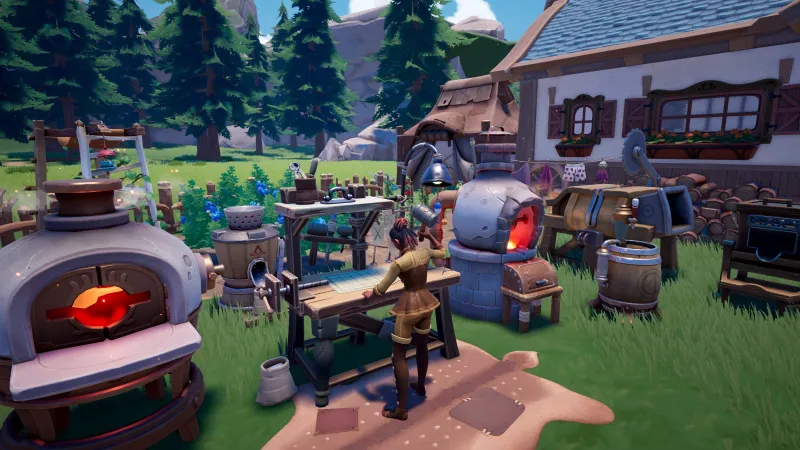
Place a mixing station, a stove, a preparation station and other items to make dishes using a collection of recipes. There are minigames associated with these tasks. Chopping food, for instance, is a timer game in which you must hit the nodes. The cooking process is time-limited, and too much cooking can result in burnt food. Thankfully, though, you can’t start any kitchen fires. Unfortunately, I didn’t play long enough to build a kitchen and try these systems out myself. Food builds Focus (a bar, which is your stomach). Focus increases your ability to perform actions. A full Focus bar will also give you bonuses for all the experience that you gain. Thus, to get the most out of everything you’re doing, you’ll want to keep plenty of prepared dishes or raw food to snack on.
As you gain experience in these activities, your ability to perform certain tasks will increase, allowing for better equipment. Eight initial skills – fishing, cooking, gardening, mining, hunting, bug catching, foraging, and furniture making – all have associated masters. Each master is assigned a certain level which adds items to the respective store. Once you reach level 10 of a particular skill, skill medals are earned to be able to buy certain store items like cosmetic trophies. This all contributes to your player level and, with no cap on levels, this number could reach thousands.
Now that I have the foundational tent and items made, I bring a glowing item I found while plowing to the town scientist, who informs me it’s a key. It’s a key. I hide it behind the waterfall that conceals a hidden doorway leading to ancient ruins. As I explore, I come across other similar doorways that each present a puzzle. First, I am given a puzzle to solve to get a key ingredient for life into a bowl. I won’t spoil the answer, but the solution opens a pathway leading to a grander area of underground ruins tied to the game’s initial mystery: what was humanity, and what ultimately happened to it?
Naturally, given the genre and the game’s MMO nature, things unfold at a laid-back pace. It takes time for various processing machines, such as a sawmill, to create their output. Quests often only progress once a person contacts you, usually via mail, so you’ll be killing time completing other errands until that happens. NPCs retire home at night, meaning you generally can’t turn in outstanding quests until morning. Management-minded gamers have always found it appealing to manage meters and timers in life simulations. This is also true for this game. But if you’re a newcomer to the scene who’s more attracted by the main questline and the cooperative multiplayer, playing on Palia’s time rather than yours will be an adjustment; the journey is often the destination in this type of experience.
Although I didn’t interact with the scant players roaming this pre-beta period, Palia’s communal vibe is another inviting draw. Working together with friends to collect resources is rewarding for everyone, whether you’re playing on the road and meeting new people or in an established party. If someone comes to chop wood with you, you’ll both get loot. Plus, people can’t steal your stuff. You can also visit one another’s homes to admire each other and exchange furniture. You can also post public requests for materials. This allows charitable players to help you reach your goals quicker.
I’d have to play a lot more Palia to find out, but what I’ve seen so far has offered a cozy good time. The game’s potential is evident even in the early goings, and I’m curious to see how its story evolves alongside your homestead. It’s a cherry on top to be able to do all of this with a group of good friends. Palia’s closed beta begins today, but everyone else gets to jump in when the open beta kicks off on August 10. Palia, which is currently only available on PC for these closed betas will be released to the Nintendo Switch later. Singularity 6’s foundation is solid, and I am excited to see how it continues to grow as players make Palia their home.
#Palia #Preview #Building #Life