Mega Man X’s character design took big steps forward
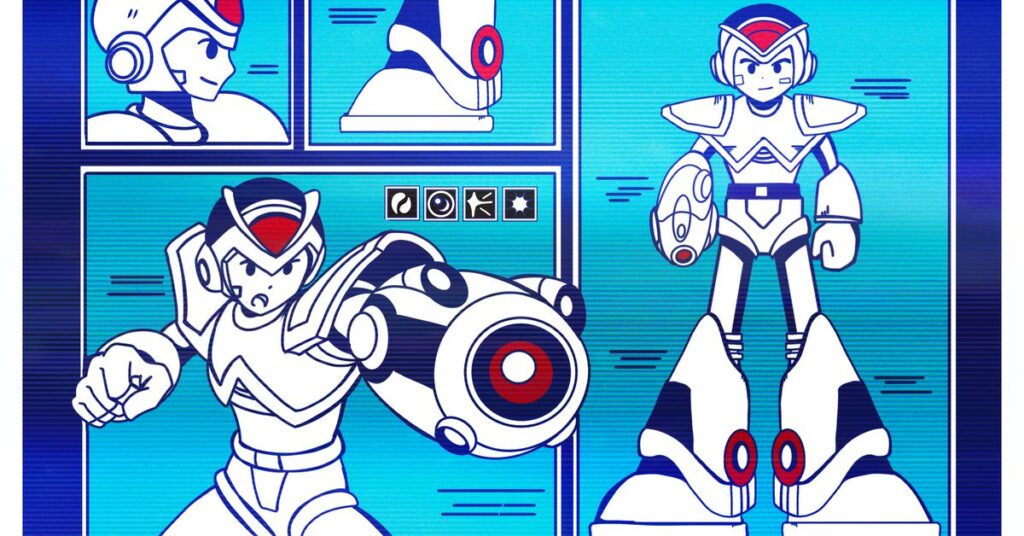
Over the years, Mega Man along with Maverick hunter X have helped to defeat the evil Dr. Wily. But even those familiar with the Mega Man franchise don’t know much about the differences between the two heroes headlining the series, as Capcom has left both as stoic icons with incomplete biographies. Thanks to the hundred-year difference between the original Mega Man’s crusade and the time of X’s adventures, though, one thing is clear: Much has changed in the franchise’s attitude, style, and accessorizing.
Mega Man, introduced in 1987, was undoubtedly a hero, but that young construct was also very plain — all heart and no lasting impression. His face was flesh colored, and his edges were rounded. The only thing that made him stand out was his small size. Back in his day, being fashionable simply involved gaining new powers and changing one’s color scheme, as a fresh splash of paint was meant to go an impossibly long way. He had to be careful that no one would notice his accessories were only hand-me downs, or that they were just parts from his faithful hound (Rush was always the most versatile of pets, and did all the work). Mega Man was stuck forever at the table for robo-kiddies, no matter how hard he tried.
X represented a breed of its own. This creation, introduced in 1993’s Mega Man X, looked older, had less to prove, and didn’t need a long handle to signal what he was when a singular letter confidently got the point across. This mechanical savior looked polished and sleeker with larger armor attachments. He also had some pointy edges. The new, refined body of the mechanical savior was more attractive and sophisticated with a gem set in his helmet. Dear old Daddy Light left him a redesigned elegant base form, along with a number of gifts that added new abilities and enhanced his appearance. X, though still brightly colored, was darker, edgier, and had a more enigmatic expression. Capcom softened X in subsequent games.
:format(webp):no_upscale()/cdn.vox-cdn.com/uploads/chorus_asset/file/24764308/MMLC_MM1_Museum___Character___Concept_Art.jpg)
:format(webp):no_upscale()/cdn.vox-cdn.com/uploads/chorus_asset/file/24764309/MMLC_Museum_MM1_Sketch02.jpg)
Moving to the Super Nintendo allowed the artists at Capcom a broader range of colors when it came to X’s look, and according to designer Hayato Kaji in the book MM25: Mega Man & Mega Man X Official Complete WorksThis new freedom allowed for greater detail, but it also made it more difficult to choose a design. It was decided that the sprite would be larger. Mega Man 7“, and Mega Man XThe character was made to stand out with a great contrast, and a very aerodynamic look. X’s growth in power also mirrored that of the game’s boss, Zero.
Inafune’s Inafune Mega Man & Mega Man X Official Complete Works, the series’ main character needed to change in part because of the success of role-playing games where characters evolved over time. “Mega Man was not shining as brightly in this light,” he said, which is why the team added more power-ups.
:format(webp):no_upscale()/cdn.vox-cdn.com/uploads/chorus_asset/file/24764320/XandZero.jpg)
The team was also inspired to add other elements, giving X access to mechs known as Ride Armors, and in later games land speeders — or Ride Chasers — presumably because someone who looks this awesome needs sick vehicles too. X is known to adopt the look of his opponents. In the first stage, MMX, players witness Vile — Sigma’s violent enforcer — using a stylized purple battle suit to dominate X, so of course, our growing hero wants one of his own. Sigma’s armor includes bracers with oversized boot tops, as well as intimidating pauldrons. in suppressed peacock colorsSigma and his partner Zero also wield flashy sabers, weapons that demand attention when they are used. Another important extension to the ensemble our hero strives for and eventually receives. Sigma and Zero both wield flashy blades. These weapons are loud and draw attention. They’re an important addition to the outfit that our protagonist strives for, and ultimately receives.
X strives to improve, evolve and grow. Dr. Cain’s journal from the game’s manual told us that he was worried about X being “unsure of his place in life” due to the free will Dr. Light had given him, as he had to choose the path of violence in order to help Zero. Mega Man didn’t have this problem and wouldn’t care about what others thought of his actions (he could make judgments, but didn’t have full free will), appearance, or bettering of himself; there was only the task at hand. X was driven to surpass his predecessor and everyone by acquiring more exchangeable armors in the subsequent games. This went beyond his means. Even the Street Fighters stole his ostentatious, highly-effective specialized moves. acquired golden armor at one point, similar to Arthur’s from Ghosts ’n Goblins, keeping it in the Capcom family.
It’s no surprise that someone this fashionably versatile, robot or not, would find that passion to keep changing and unlocking their visual potential amid threats of failure and self-doubt. Mega Man’s older self was doomed to fail against time. He had become a victim of himself, and would never learn the importance of changing his wardrobe.
#Mega #Man #character #design #big #steps