Exclusive Early Look At Dungeons & Dragons: Onslaught

The original Dungeons & Dragons RPG grew out of a connection to miniature wargames, so it’s little surprise that the DNA of tactical tabletop play has remained bound to the long-running franchise ever since. The current edition of D&D supports tremendous flexibility in playing out combat how you like, including through tabletop miniature play, allowing big battles to flow out from ongoing campaign storylines in your weekly sessions. Your group might be more interested in combat than the interconnected storylines. You might just need a moment to take a step back from campaign planning and have an evening of focused combat. If that’s the case, WizKids’ new Dungeons & Dragons: Onslaught game should be on your radar.
Recent weeks have seen what Onslaught will bring to players, when it launches in 2023. As a D&D player since childhood, I was eager to see how the game would break down the complexities of D&D battle into a fast-moving tactical game. After a lot of testing, I was impressed with the results. Onslaught is a love letter to what makes D&D combat at the table so fun, but streamlined and focused for fast exchanges, balanced one-vs-one competition, and accompanied by minis and other components of stellar quality.
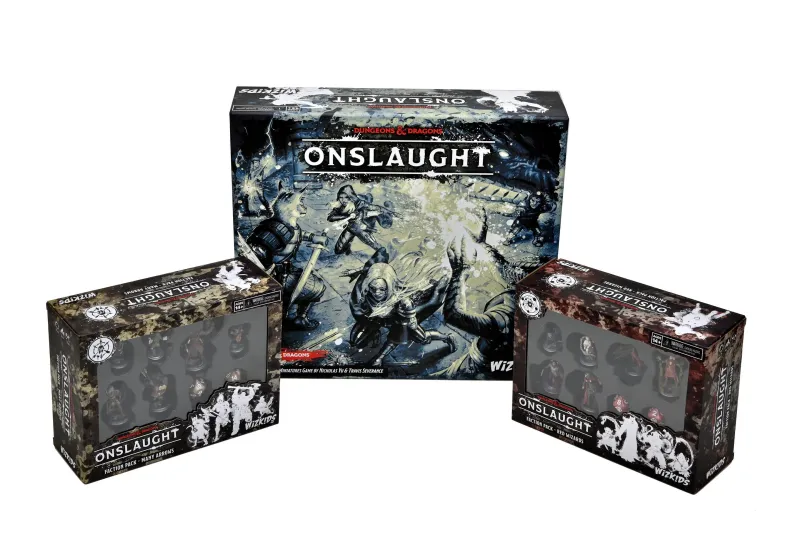
Onslaught will release its core set for $140 and the faction expansion packs for $60
Dungeons & Dragons: Onslaught is a two-person competitive skirmish game. Each player controls members of an adventuring party from a specific faction drawn from the Forgotten Realms fiction. This core launch box contains members from the Harpers and long-time enemies, the Zhentarim. However, I was also able to see some subsequent faction packs for groups such as the Many Arrows clan orc clan or the dark ranks the Red Wizards. While you are required to only build your team from people of one faction, there is a fun exception that allows mercenary teams to be drawn from any other faction. So, one of the game’s other first expansions is a mini four-pack of Sellswords that can join any team.
After trying out many group combos, I have come to appreciate the carefully balanced mix between these different asymmetrical factions. Each group has shared roles like Melee damage, healer, and tactician. Every mini hero is unique and I enjoyed seeing the results of new teams against established ones. Mistral, the Zhentarim Cleric, and Chloe Amasnodel, the Harper Bard, enter combat as healers. They have abilities that allow them to revive their fellow teammates. However, Mistral’s Sacred Flame ranged attack completely differs from Chloe’s Vicious Mockery ranged power. And since players select their team from a broader faction, there’s no assurance that either will show up in the current session.
Faction limitation ensures that you have a stable, competent group of people with different roles. But there are plentiful team-crafting opportunities even with the core sets, which will only expand if you invest in a particular faction’s inevitable expansions.
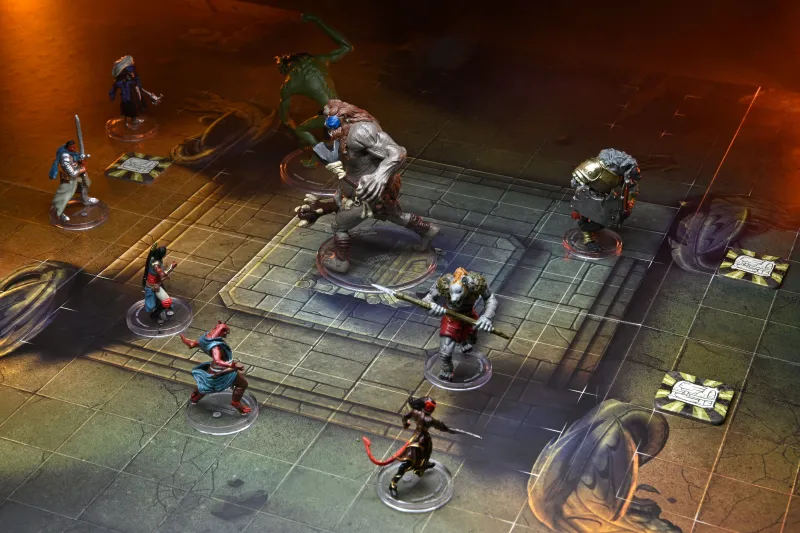
Pre-painted miniatures show great details in both sculpting, and painting
Onslaught’s focus on scenario-based play is what I really love about it. It also includes monster minis, which can throw off any well-planned strategies to take out your foes. Onslaught has a unique narrative structure, which is unlike other miniature skirmish game formats. Indeed, you’re battling against the opposing players’ miniatures, but you’re also focused on objectives, defeating NPC monsters, and gathering victory points. In one early scenario, you’re infiltrating a dungeon infested with kobolds and a particularly nasty troll. For victory, you must target and defeat all enemy characters. Failure to accomplish this will result in the loss of victory points. The player who has the most victories after eight rounds wins. If your opponent survives your attack, they may have loot or dealt damage to you.
Scenario play not only adds an interesting narrative to the game but also dramatically enhances its strategic potential. The monsters in battle pose a challenge to both the players and are constantly moving. This means that you need to balance defense, attack, recovery and objective goals each time you activate minis.

This core set includes a number of different cardboard parts, along with a convenient bag that can be used to keep them all organized.
Movement and attacks leverage longtime D&D vernacular and concepts but simplify the flow of how those elements play out. A character can use a standard, move or bonus action on each turn. Each card that you have has an icon which will indicate the type of action it takes. The bonus action is Healing Word. A swing of your barbarian’s great axe is a standard action. Some powers might even take a Standard and Move action together, like your Monk’s Stun attack.
The majority of powers are based on rolling two 20-sided dice, and then taking the best roll. Is the defense character covered? You can only roll one die. Add up some modifiers, and if you meet or exceed the target’s AC, your action has a static damage amount or effect that’s dealt. The tactical complexity comes through the intelligent use of the terrain for cover and the hindering of enemy movement, but also through the application of an array of applied conditions (represented by tokens) that can affect an enemy’s capabilities, like Dazed, Slowed, or Rooted.
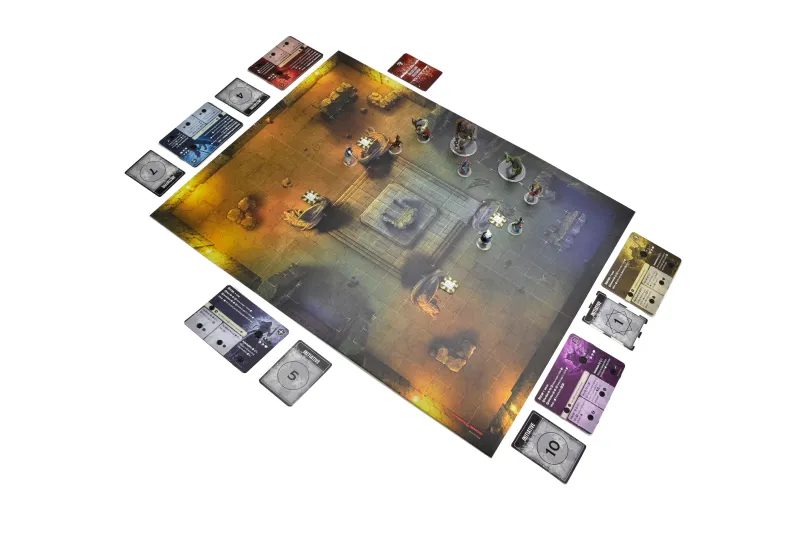
This game is played on a two-sided board. The core set includes two maps.
Instead of any bookkeeping or writing on character sheets the way you might in a real D&D game, Onslaught handles character progression, damage, and cooldowns for powers with dials on the character and monster cards. On one dial, traits like AC and speed are displayed. You must activate one of your signature powers before you can use it again. You can also earn XP by completing a variety of actions, such as defeating enemies or using certain abilities in battle. This is tracked along another dial. You can gain five XP and choose from two unique level-up cards that are specific to you. If Rokpyratrix, the Clanless Sorcerer is leveled up, you will be able to gain Draconic Ressilience or Elemental Affinity, which allows you to do more damage with Arcane abilities.
Pre-determined terrain layouts are used to play out battles. Smart layouts and reference maps within the rulebook allow for easy navigation on these large rectangle battlefields. Two excellent battle scenarios can be created by the double-sided dungeonboard included in the core set. However, the current limit of those two maps does feel like it holds the core game back a bit; even more than the expansion of character options, I’ll be eager to see new battlefields come into regular play as expansions roll out.
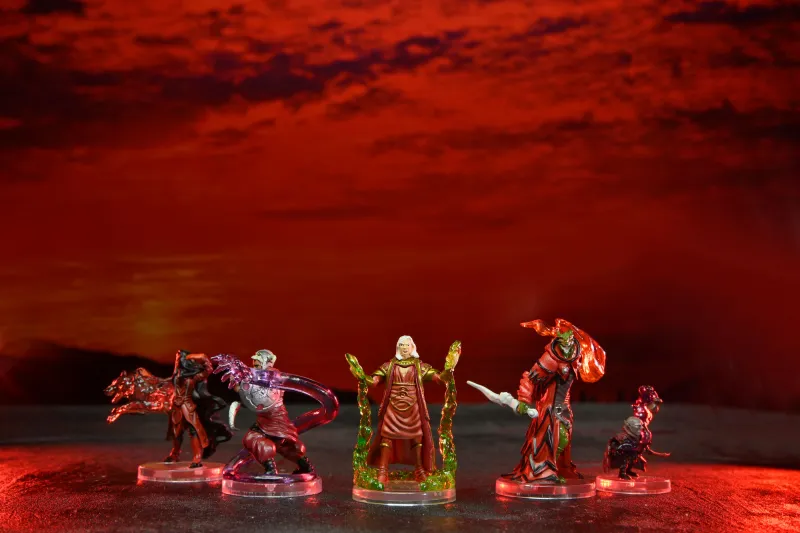
After Zhentarim’s core release, Red Wizards was one of the first factions to enter the game.
This is how it plays out at the table. Perhaps it’s my longtime familiarity with D&D terminology, but the first thing I noticed was how fast I could drop into a comfortable flow of play and immediately settle into the joy of tactical considerations. That’s in contrast to some other tactical minis games I’ve tried that take multiple sessions before I even grasp the fundamentals. Beyond this, I enjoy the variety of factions and characters available and trying out each one. The micro-decisions that I make between engaging an opponent and completing objectives or taking down monstrous foes are what I enjoy. Battles remind me of some of my favorite encounters in D&D games over the years, with tense showdowns and outcomes that often hinge on some critical dice rolls in the final minutes of combat. Although I am less invested in the plot and characters, these conflicts are still great fun.
It’s also worth noting that as I played, WizKids’ longtime expertise in pre-painted minis and terrain systems was in full evidence. Beautiful, detailed paintings and expressive poses are evident on many of the minis. This is especially true for the taller monster minis such as the Young Black Dragon or Ettin. The card art uses distinct characters silhouettes and colors to easily connect minis and cards. Also, the boards look great. While the two launch battlefields are somewhat subdued and darker, there are still unambiguous visual identifiers to help show walls and other barriers while still keeping the art as the focus – rather than a mess of icons or hard lines that break immersion.
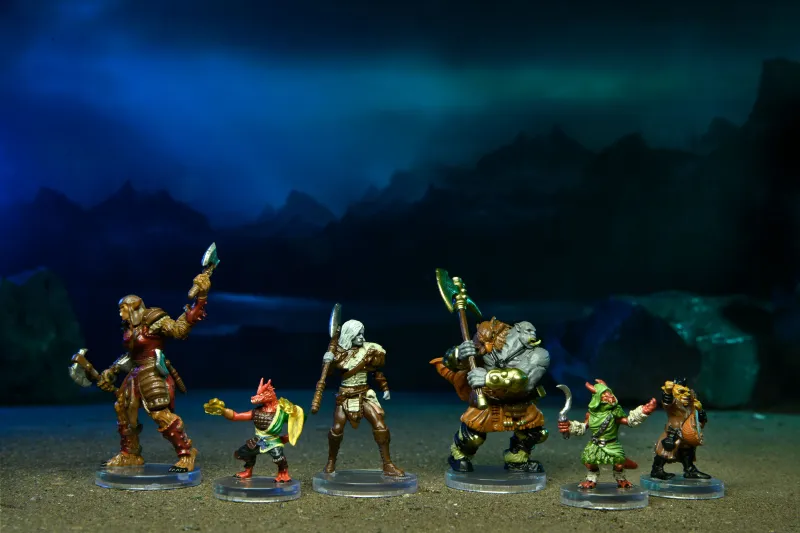
One of many factions from Forgotten Realms that players can discover through expansions is the Many Arrows.
While I’ve had limited exposure to how it works, I’m excited about another feature being promised for Onslaught; WizKids plans to integrate playability for other D&D miniatures into play, using a combination of card packs and downloadable scenarios that integrate new monsters and heroes into the mix. Over time, the goal is to allow at least some of your collections of Icons of the Realms (pre-painted), Frameworks (deluxe buildable minis), and Nolzur’s Marvelous (WizKid’s unpainted minis) lines into official play, including for use in organized play at Onslaught hobby events. That won’t affect everyone, but if you already have a robust WizKids mini collection, it could mean you already have a meaningful headstart on building your factions.
While WizKids is undoubtedly considering Onslaught as a longtime investment with an active cadence of expansions and growth, I should add that Onslaught’s core launch set is an exceptional standalone game in its own right, based on my time with it. There are 21 minis that can be painted and included in the box. This gives you a wide range of figures. The scenario book also includes seven story scenarios that can be replayed, and a few more general match types. One full gaming session can last between 90 to 120 minutes. These scenarios are enough for most players to keep them busy long enough that they don’t feel the need or desire, to purchase new content.
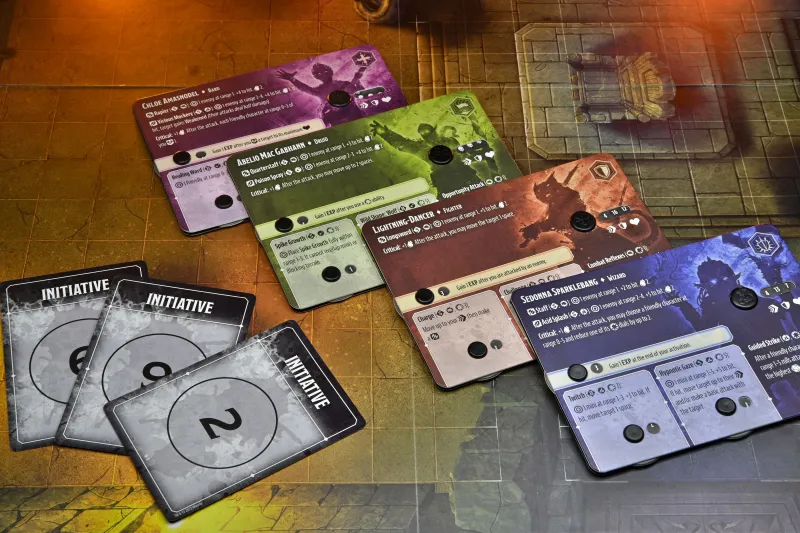
Smart, streamlined rules translate D&D terminology and mechanics into a brisk combat-focused system
With the connected D&D license and WizKids’ expertise in miniatures production and prior tactical games, Onslaught has enormous potential to disrupt the miniatures gaming scene as it takes off in 2023. Based on several hours of experimentation and discovery, I’m happy to report that such a disruption, if it occurs, will be well-deserved. Onslaught is a strong and flexible game system with a lot of life; I can’t wait to see how it grows once players start digging in after release.
If you’re interested in some other great tabletop games to explore, feel free to click on the Top of the Table hub for additional recommendations. If you have a question about Onslaught or any other tabletop adventure you’re hoping to undertake with your family or friends, don’t hesitate to email me with questions, and I’ll be happy to answer what I can.
#Exclusive #Early #Dungeons #Dragons #Onslaught