What I Learned Designing My Thesis Game

Over the course my MFA program at NYU Game Center I produced 12 small games, both digital and analog. My thesis was the focus of my time. By graduation, I’d worked as a writer/narrative designer on prototypes, vertical slices, documentation – you name it. My thesis was approved for a post-graduation grant, which I received after much revision. Although I was able to complete my thesis within a very controlled academic setting, the stress levels were high due to short deadlines. The lessons learned about creativity and collaboration were valuable.
It’s an ordinary school night, and I’m on a video call with my friend Jude. As they casually browse through graffiti-adjacent art, I also see short clips from Ponch: Cyberspace Inspector. They give me a rundown of the game’s mechanics, inspirations, and vibes, which include phrases like “platformer,” “Ace Attorney-inspired dialogue puzzles,” “detective work,” and “hack the internet.”
They light up as I ask them about the story. Jude informs me of a virtual dichromatic city full of hacktivists and government surveillance systems. A slum world oozing with Persona’s unmatched flair. Above all, Ponch Cyberspace Investigator celebrates resistance. The game is about a group of eccentric BIPOC lesbians trying to confront their dystopic society.
Suddenly, Jude clarifies that this is merely an idea they’ve worked on in tiny bursts over the past few years. “It’s not concrete,” their modest silence seems to imply. Yet, I still want to be in.
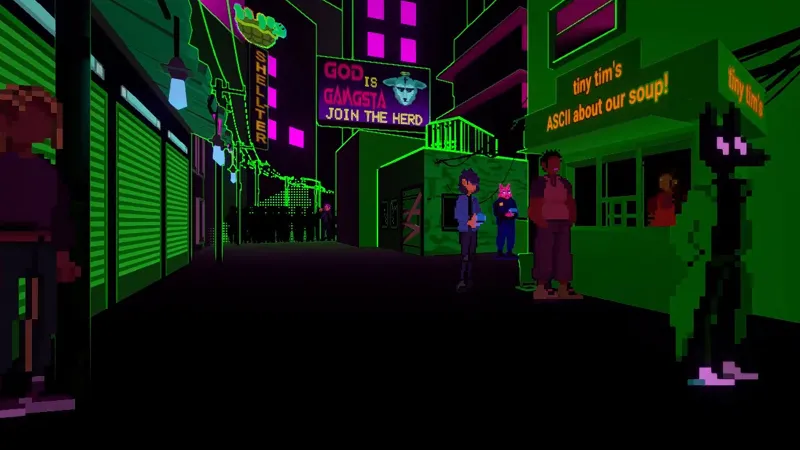
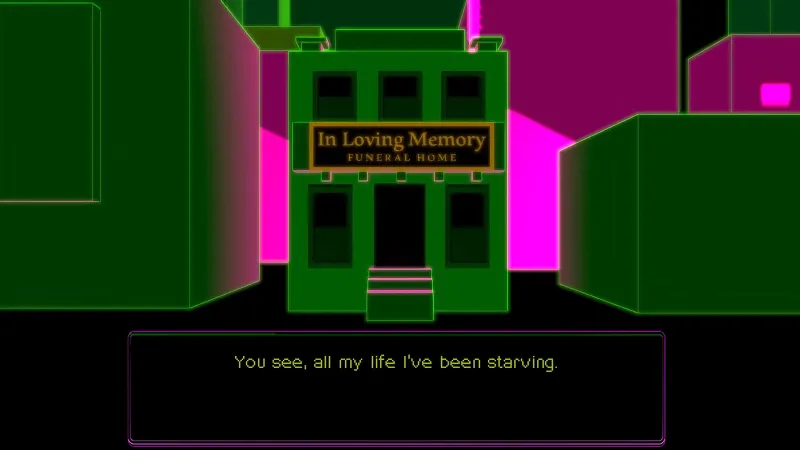
At the beginning of Thesis class, we post extensive character maps, wireframes for scene compositions/U.I. We also post various mood boards and layouts to our Miro digital whiteboard, which allows for remote collaboration. While Jude tinkers with the menu dialogue system, I draft an opening scene based on their initial vision – Ponch, a dirt-poor private eye running an illegal practice out of the basement of an abandoned funeral home, is hired to find a missing person.
As the first few rounds of milestones drew near, Jude works closely with a cinematographer and adds dynamic camera angles to character conversations. Then, after finishing my screenplay, we implement text and spend the entire night-before debugging. It takes several long weeks to create a three-to-five-minute proof of concept highlighting those aforementioned Ace Attorney-inspired dialogue puzzles.
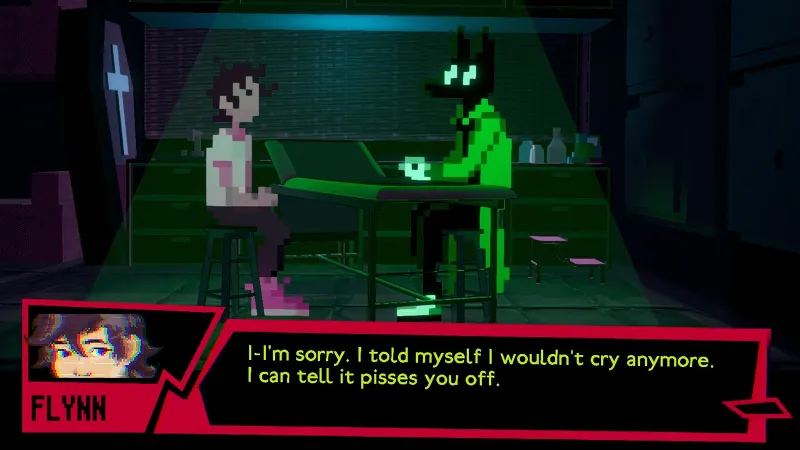
As Ponch, the player probes a client about events leading up to the disappearance of their girlfriend. After clicking on inconsistencies in the client’s testimony, the discussion continues. Faculty feedback seems worrisome as there’s still a critical question that needs answering: “Beyond interrogations, what is the central loop?”
We need help. So, Jude and I recruit Katie, a talented programmer who voices an interest in working on our gameplay systems. Fast-forward, the workload decreases, giving room for playtests, and more iterations. We spend hours debating a primary hacking mechanic that parallels our gritty detective narrative. And after much deliberation, we land on giving players the ability to hack psyches, infiltrate minds (or “Mindspaces”) for info/secrets, and, consequently, make investigative breakthroughs.
Mindspaces are minigames which rely on visual storytelling in order to draw out the personality of others. How could the player be made to feel smart? We return to dialogue puzzles and make revisions inspired by age-old, cartoonish detectives armed with nothing but pens and pads. Instead of simply clicking through dialogue in search of contradictions, we build an inventory system for collectible quotes that players present to NPCs during key instances. By giving players more agency in how they respond to other characters, confrontations are more dynamic and gratifying.
Solidifying these mechanics while polishing U.I., FX, and general juiciness (the embellishments that make play satisfying) takes almost six months. For our final milestone we are proud to submit a twenty-minute playable demonstration. The Ponch Cyberspace Investigator allowed me to tell a queer tale while learning how to take constructive criticism, and allow for constant revision in a small group. My thesis game was a great way to learn trust, curiosity, and playfulness.
This article first appeared in Game Informer Issue 350.
#Learned #Designing #Thesis #Game