Madden NFL 23 used James Cameron’s Avatar tech to film its scenes
Brian Murray (who in an earlier life carried 16mm cameras for NFL Films), lowers the camera onto my right shoulder. “This is the same size, weight, and balance of a camera that I would be shooting if I was on a sideline again,” says Murray, Madden NFL 23’s creative director for presentation. But it doesn’t look anything like a digital camera.
Metal tubes approximate the skeleton of one, and some dials at the front control things like focus and zoom, but it’s mostly open space attached to a rather chunky platform. The viewfinder is an iPad, so at least I’m not squinting. The viewfinder shows Sean McVay as head coach and the Los Angeles Rams, who are coming off the field at the conclusion of a Madden-generated game. And as I move the camera, I’m filming in virtual reality, walking up close on Jalen Ramsey or Sebastian Joseph-Day and getting in their faces, just as if I had a photographer’s vest and field pass.
“You may have heard of a very small film called Avatar,” Murray jokes. “James Cameron patented a technology where he was able to take a small, wired kind of pad and walk around in his digital scenes in that movie, to get authentic-feeling shots, to frame the digital scenes in that movie.”
Murray joined EA Sports from NFL Films, the league’s Emmy-winning documentary arm, to begin work on 2014’s Madden NFL 25. Murray was brought aboard specifically to tune Madden’s in-game broadcasts to more closely resemble the kind of rich cinematography football fans have come to expect from the league’s biggest games and moments — and from the even more cinematic NFL Films. Murray started using the VR filming technique that Cameron had invented shortly after he moved to Florida. Since then, Madden’s broadcasts have been able to film what is essentially the same sequence from a variety of camera angles — in a number of different styles, each one true to life — to inject some variety into the game’s presentation.
You can see the difference. “My last room that I had to do this in, it was the size of this piece of carpet,” Murray says, gesturing at a rug marked with gridiron lines and an EA Sports logo, at best the size of a closet floor. Today, he is working in a much larger and much newer motion capture studio at EA’s downtown Orlando studio, where EA Tiburon moved in 2019, shortly before the pandemic. Murray explained that the capture area was finished just a few days before we interviewed him.
The extra space means that “thousands” of new shots have already been filmed for Madden NFL 23 — 700 in the week before a late May studio tour, Murray says — adding to more than 12,000 filmed over the seven years this technology has been in use. Murray is right that the past Maddens offered varied animations to keep the film’s cinematics fresh and interesting after the whistle or halftime gun. But looking at the new space he has to work with, I can’t help but think he can more properly frame up a shot from a sideline camera now that he can literally move himself away away to that sideline, in virtual reality.
“For us, we always want to start it grounded in reality, and then start to push the buttons from there,” Murray says. “Otherwise, we would just have 1,000 drones flying all over the place. Then, we are faced with a unique responsibility. Our fans can watch this game from their couch on Sundays, Thursdays, and Mondays. So if we don’t represent from day one right there, and if we don’t simulate our game the way that you’re pros at watching, then we’ve failed you right then and there.”
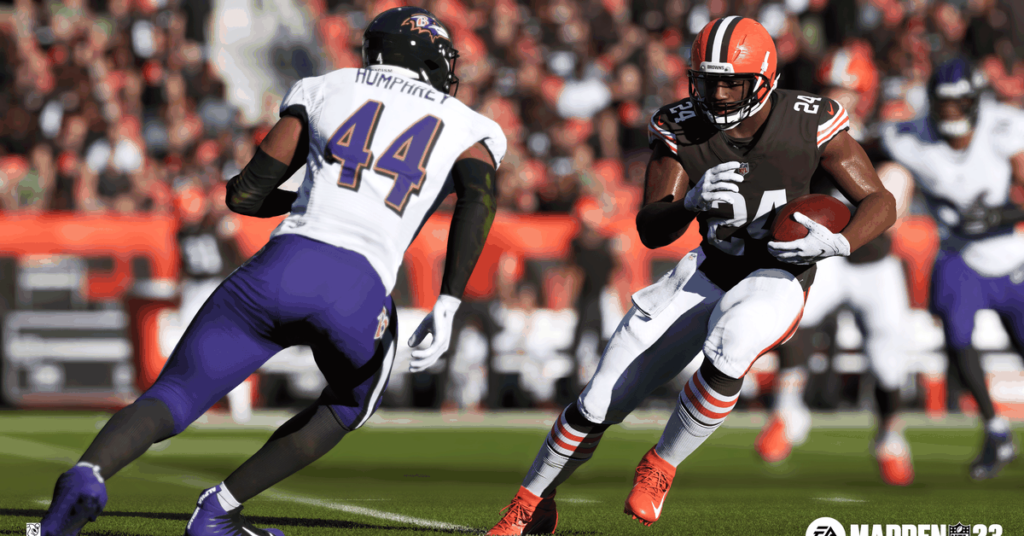
The D-Cam, or Director Cam, is only one component of a focus on visuals and presentation that isn’t necessarily an overhaul, but is an emphasis on making sure everything in the game is rendered with painstaking authenticity. Sports developers usually back this assertion with figures about how many 360 degree head scans have been done on athletes to add them each year. Madden NFL 23 Indeed, there are more.
But the “Mobile Scan Truck” that EA Sports parked outside Kansas City’s Arrowhead Stadium last year, and during events like the NFL’s league meetings and scouting combine, speak to the persistence behind the effort led by Terrance Newell, Madden’s art director, and Juan Chavez, its characters director. The truck wasn’t just there to do mugshots. Newell tapped five Kansas City Chiefs of various heights and, er, widths to better represent the spectrum of NFL players’ bodies. Until this year, Madden had used a single base model, or “silhouette,” that was then altered to represent bulkier or leaner archetypes.
“Admittedly, if you look close enough, all those different players kind of have some of the same traits, right?” Newell says. “Because they’ve been built off the same base. We were, OK, let’s make accurate bases, which will make the entire roster of players more accurate.”
The five Chiefs they scanned wore their gear into the truck, too, which included the 6-foot-8, 344-pound offensive tackle Orlando Brown Jr., whom Newell says represents the “edge case” player — guys who are in the league, but in small numbers. (The other four represented “speed guys” at quarterback, receiver, and defensive back; “impact players” at running back, linebacker, and defensive end; “monsters” who play offensive line and interior defensive line; and “tweeners,” who are some unbalanced combination of size or speed, typically at quarterback or on special teams.)
Newell recalls Brown having to sit down and hold a position to allow his upper body to reach the scanner. “He was a trouper,” Newell says. “Held that pose the entire time.”
The result isn’t just that more players’ bodies are believably proportioned in Madden — their gear also hangs on them a lot more authentically. “The detail and the nuance, how tight the jerseys are, how thin the pads are now, even [on offensive linemen], which even looks dangerous, to be honest — that stuff all shows up one-to-one in the game now,” says Mike Mahar, Madden NFL 23’s senior producer.
EA Tiburon also utilized the scanning technology in gear to detect the color under direct sunlight. This is especially true for throwback uniforms, which might have been slightly more subtle or darker than the original. For modern gear, that means that a lot of Nike stuff was marched into the office under armed guard, literally, because the designs haven’t been shown to the public yet. To complete the retro look, John Madden is featured in All-Madden’s new installation. Madden NFL 23Chavez went to an antique clothing shop and bought the same two-pronged belt with a button-down short-sleeve shirt that Coach made famous.
“You heard us talk about Coach [Madden] quite a bit, and how he’s inspired our team; he was super passionate about authenticity,” Newell says. “You know, if it’s in the game, it needs to be in the game.”
[Disclosure: EA Sports invited Polygon and paid for its flight and accommodations at the one-day preview event at EA Tiburon’s studio.]
#Madden #NFL #James #Camerons #Avatar #tech #film #scenes