Life And Death With Ikumi Nakamura

“I’m always thinking about death,” Ikumi Nakamura tells me, as we ourselves are, in fact, confronted by death. It’s late at night. I don’t have any distractions, such as cars or people. I can’t avoid what I’m seeing: a host of creatures about to be murdered.
We’re standing at a slaughterhouse. But it’s a slaughterhouse in a deeply strange location, or, as Nakamura calls it, “Silicon Valley,” the technology district of Shinagawa in Tokyo, Japan. As I look at trucks packed full of cows at – whether they know it or not – the end of their lives, immense skyscrapers surround us, housing tech goliaths. Cannon, Microsoft and Sony all have their offices in this area. The lifeblood of Japan’s tech industry, all looking down at death, turned to process.
“The city is so new and alive, but right in the same place, there’s animals being killed,” Nakamura observes.
This “gap,” as she often calls it – life and death, new and old – commands our conversations as we explore Shinagawa’s empty streets and back alleys. If anything, the two sides of Nakamura’s own life coalesced here; her old life working at Tango Gameworks leading Ghostwire: Tokyo and her new independent studio, Unseen.
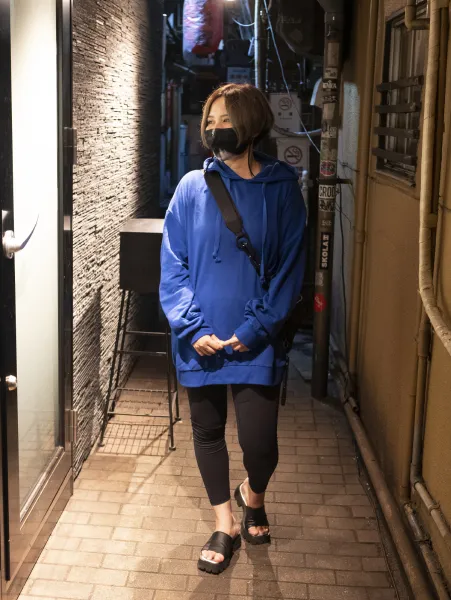
Ikumi Nagamura
After 15 years in the game industry, first working at Capcom on Ōkami, then at Platinum Games on Bayonetta and the canceled Scalebound, then Tango, Nakamura became a viral sensation with her appearance at E3 2019, joyously and nervously announcing Ghostwire. Nakamura claims that her sleep problems began when she was too stressed out by the work of creating Ghostwire. She’d walk around Shinagawa late at night, long after the business people usually filling its streets had gone home. She’d have the city primarily to herself, just as we do now. “I discovered many things,” she tells me, “and became friends with thecockroaches.”
She decided to leave the project and start Unseen. Unseen was originally founded in Shinagawa, in a space that she shared with four others. The studio has since moved 20 minutes away to Tsukishima, but nevertheless, it’s hard to deny the thematic appropriateness of all the new, old, life, and death of Shinigawa and how it neatly fits into Nakamura’s story here.
“When I established Unseen, I felt like I had to run away from old things,” she says. “From old vibes, old atmospheres. Some people wanted to go with me but I decided not to. That was because I wanted to create something new, so I didn’t want to bring too many old things with me.”
Ironically, the entire trip begins with Nakamura’s slide into a back alley that transports us to a new dimension.
Get Trapped
Nakamura asked me to meet her late at night. I show up roughly between 10:30 and 11:00 p.m., and as I wait outside Shinagawa Station – one of Japan’s oldest train stations, opened in 1872 – I see the final rushes of people making their way home. Eventually, Nakamura and Unseen community manager and assistant producer Kyoko, who’s also helping with translation, show up, and we walk across the humongous train station.
“There’s so many salarymen around here shambling around like zombies,” Nakamura says as we walk past scores of men in white shirts and ties, most carrying briefcases, all looking exhausted.
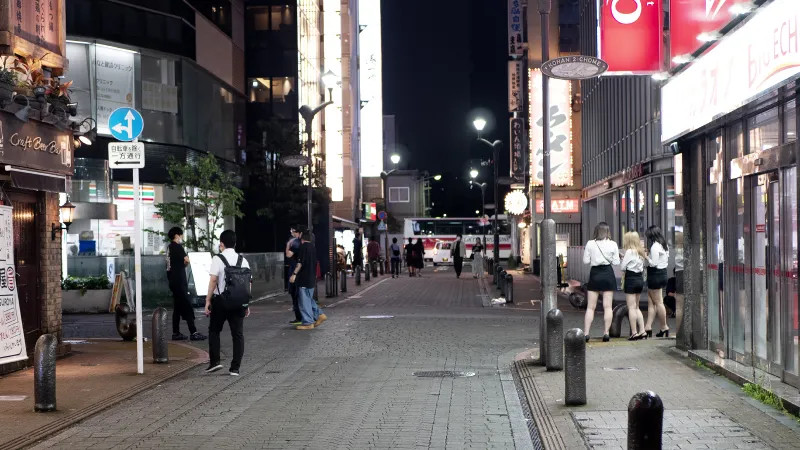
Walking past Shinagawa Station and a shopping center, you will find yourself outside an extensive eating-and-drinking area. Honestly, it looks like many downtown areas of Tokyo these days – clean, mostly new, fairly nondescript, and indistinguishable from a million other restaurant areas in business districts. Again, it’s late at night, on a weekday, no less, but a handful of people are still milling about looking for food or drink. However, there aren’t many as rows after midnight of waiting taxis and young girls in tight clothing, trying to drag people into bars, stand by. We’re not going to be much help to them, as before I know it, we duck into an alley behind all this boredom, slipping by a Yoshinoya fast food restaurant and a real estate company.
I don’t know where we’re going – though that’s somewhat by design; as part of doing these pieces, I don’t ask for specifics, letting it be a surprise – but a tight, dirty alley I can barely walk through is a bit disconcerting. Until we make our way through, and I realize there’s a hidden city behind the boring storefronts on the streets. These new buildings are actually built around an entire neighbourhood back here. They trap a dozen to twelve older buildings within a modern frame. You’d never know it from the streets, and the best way to see this weird blender of old and new is to look from above on something like Google Maps.
Our dirty alley entrance was also a sham, as once we’re back here, it’s incredibly clean and nice – at least compared to American alleyways. Every hidden building has a minimum of two-to four stories height and houses little restaurants and bars. This is not unlike the outside world, but crucially, I don’t notice any major chains, and there’s certainly no one outside begging us to drink in their empty bars like before. The only remaining establishments that are open here are left alone. It seems to me that you should come in if possible. You should take a seat. If you don’t, that’s fine. It’s that simple.
This here, the way we slipped back in time, is the gap Nakamura talks about – that the old and new coexist so closely together. “I just love that gap,” she says. “I like that gap, in all things, in the culture.”
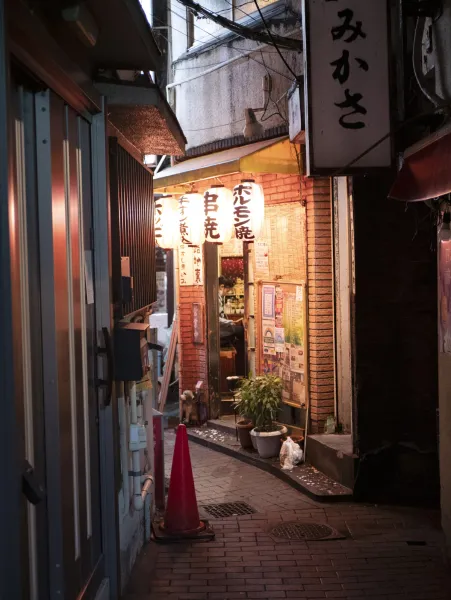
However, this gap is indicative of the fact that new buildings are encroaching upon the past. Japan, like most large cities, is losing a part of its past as new buildings replace the old and gentrification sweeps through. The new blocks the old from the spot where they were just minutes ago. If I look up towards the sky, I see the skyscrapers looming over this little time capsule we’re standing in – like the universe is sending me an obvious metaphor. But, for Nakamura this is just the natural order.
“In time, the new buildings here will grow old, and one day they’ll be swapped out once again for some amazing new buildings,” she says. “Long after we’re gone, of course.”
Nakamura says she believes our environments shape us; it’s why she wanted to become an environment artist earlier in her career. Ghostwire, her first title, was based on Tokyo. Though it’s worth pointing out that now that the game is out, Nakamura says she hasn’t played the final version.
She even claims to be able to picture her surroundings from a bird’s eye view, visualizing how streets and buildings all connect. “Even when I’m walking around myself, it’s like I’ve got a camera above me,” she says, laughing. Considering her work and definitely evident in our conversations, it’s clear Nakamura is obsessed with cities. However, she’s obsessed with them in her own unique way – namely, when they’re empty.
Her upcoming book, Project UrbExA photo album that chronicles her adventures in abandoned buildings throughout the world, titled. She also invited Archipel to follow her around Japan’s abandoned buildings during one of her first interviews. She’s spent a lot of time walking around the city alone at night in her day-to-day life. “When I was working at Tango, I’d go out three or four times a week,” she tells me. Ghostwire is a story about Tokyo citizens going extinct. Finally, when I emailed her asking if she would like to be interviewed, one of her first notes was that she wanted to meet up late at night – even floating the idea of waiting until as late as one in the morning – all so we could see one of the biggest cities in the world empty of its millions of inhabitants.
[Full disclosure: The author of this piece is working with Project UrbEx publisher ReadOnlyMemory on a separate book. However, he is not tied to or associated with Nakamura’s work with the company in any capacity.]
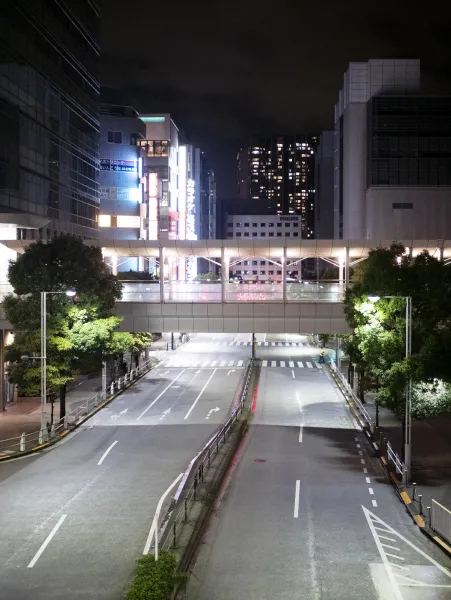
And to her credit, it’s a fascinating way to see an urban space – especially one as large as Tokyo. Coincidentally, I’m staying in Shinagawa for the week I’m here, but only see it during the day, when it’s full of who knows how many people living, commuting, and working. This is the first time I’ve come out this late at night, realizing that after 10:00 p.m. or so, this place is empty. And yet, the city functions – the lights are still on; traffic stops cycle between red, yellow, and a blue shade of green; crosswalk speakers play chimes to indicate when you can cross the road. They all signal things that nobody is able to hear or see. At night, it feels like the city doesn’t need us anymore; it’s a clock we’ve simply wound up, and from there, it keeps itself in motion. Its only function is to serve us. She may have left Ghostwire before it came out, leaving a different director to see it through, but this is unavoidably exactly the same as the Tokyo in Ghostwire – devoid of people and yet still functioning all the same.
“You’ve got this city full of people; it’s always moving,” Nakamura says. “But at night when no one is around, when everyone is in bed asleep […] it’s like the city is alive. It gives me a strange, almost spooky feeling.”
“When there’s less people around, you can see and perceive the actual environment, the real city,” she says.
We walk further into Shinagawa and the only remaining bars and restaurants close to us vanish as we pass the narrow alley. We’re truly alone in this mammoth city like someone left an entire concrete jungle to us.
That’s us, and several cows.
The Difference Between Life and Death
Before you can see the cows, it is easier to hear them. When there are no cars, trains, people, or noise pollution to drown it out, all you’re left with is the sound of animals on their way to death.
It occupies an entire block in the center of the city. Mostly, high walls and windowless buildings block passersby from seeing and ostensibly thinking about what happens here – except for the far south side, where the walls break away to let trucks enter the facility. We’re standing here, staring at trailers full of cows in the middle of the city’s tech district. Maybe I’m projecting, but they look scared. It’s sad.
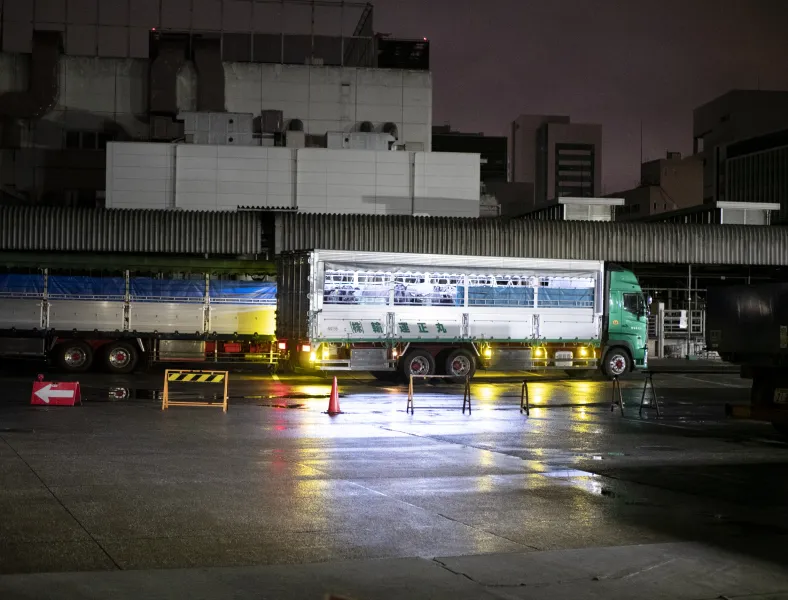
Nakamura, embarrassed by my fear of death, has to admit that I do. It’s something I think about constantly. She tells me she’s also always thinking about death, but with a crucial difference. “I’ve never been scared of dying,” she says. “Even when my child was born, my feelings haven’t changed.” She doesn’t see it as an end – the root cause of all my fear; that there’s nothing beyond this. It is moving forward that she prefers.
“Maybe it’s simply that there are different planes, different dimensions of existence,” Nakamura says. “We’re all in the same space, but we can’t cross over. So for me, when I think of death, it’s not dying but moving. When my father died, I didn’t feel that sad because he just went somewhere else.”
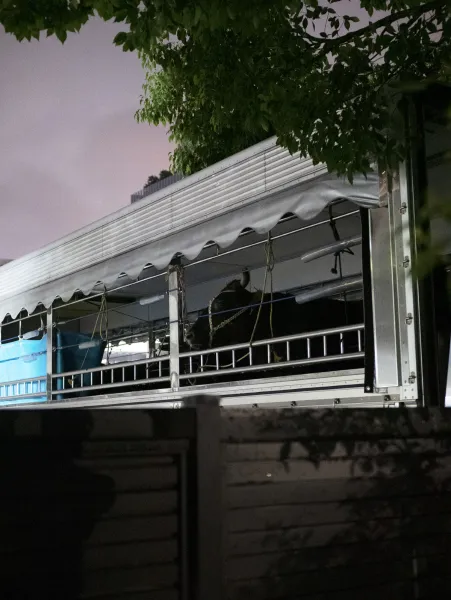
Nakamura continues to move forward in her personal life. Unseen was her first venture after leaving Tango. Her previous job was inspired by her family. As she now manages a global studio, her inspiration comes from everyone’s perspectives and backgrounds. “They’re from many different countries, so I feel like I’m seeing a glimpse of their culture through their work, and that’s been inspiring to me,” she says. However, despite leading the company, Nakamura says she doesn’t see herself as in charge of Unseen’s future; she wants the company to decide together. Unseen hasn’t even announced its first project, though. The future will only be known with time.
For now, we’re taking one last look at the past. About 1,300 feet of green space is located just across from the slaughterhouse, between rows of high-rise skyscrapers and office towers. The view of the skyscrapers and buildings is barely obscured by trees that hang above us. If I were to come here in the morning, Nakamura tells me it’d look completely different. “It’s zombies everywhere,” she tells me. “Zombie businessmen” will be walking these same streets. If that is the case, you might be able to fully appreciate the night and all the opportunities it offers. “The night is all I have,” Nakamura says, laughing. “A mother is only free at night.”
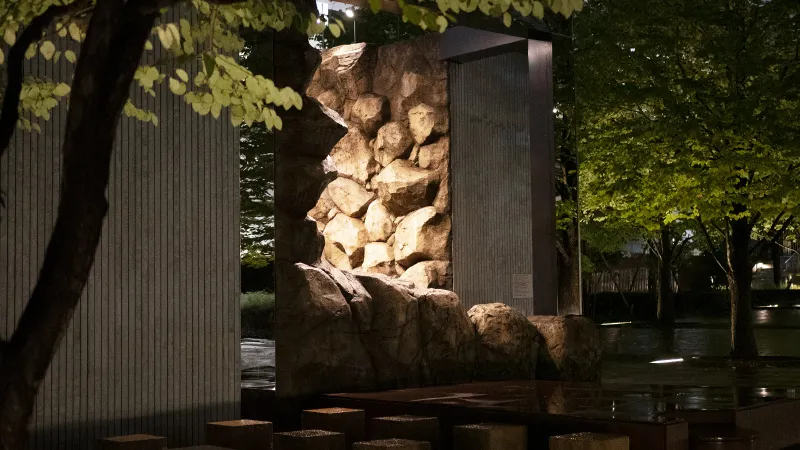
One year ago, Unseen was her first book. It wasn’t long ago, but she says she feels nostalgic. That said, in life, Nakamura says she’s always looking forward – which might explain why she’s always thinking about death. “I don’t like ‘looking back’ at my life,” she tells me.
And while our night may have oscillated wildly between looking at the past and present, life and death, at the end of the night, the only choice left is to move forward, continuing until we, too, “move on.”
We cross Shinagawa Station and walk backwards. Then we part ways to continue into the evening.
Alex Highsmith, post-interview translation
#Life #Death #Ikumi #Nakamura