Inside The Nintendo Power Hotline
Introduction
Kyle Hudson didn’t know what Nintendo was. It was 1988. He had just returned from bootcamp and was looking for a job. Jeff Palmer, his friend suggested that they work together at Nintendo. Palmer’s cousin Cliff worked there as a gameplay counselor; he got paid to play video games all day. The latter suggested that Hudson and Palmer might be able to do the same.
“Jeff sold it to me like, ‘Hey, we’re gonna sit in a cubicle and play games all day and answer phone calls,’” Hudson recalls. “And I was like, ‘Hell yeah.’”
In 1987, Nintendo launched its Nintendo Power Hotline. A player could dial the hotline to get help from a “gameplay counselor” if they had difficulty beating a game. This was an actual call center. But it was so much more.
In 2005, Nintendo closed the hotline. Gamma counselors had already helped millions. The hotline became part of the videogame history and is still remembered fondly by those who called. Many kids considered gameplay counselors heroes. These were the people who earned a living playing video games. Counselors are the people who helped them to think about video games. For many counselors themselves, the call center launched their careers – both within and outside of Nintendo. Hudson worked for Nintendo from 1988 to 2012. He didn’t even know what Nintendo was when he first applied. More than two decades after taking his first call, he had worked his way up to Nintendo’s product testing manager.
We spoke to 12 individuals recently in order to get a sense of the experience at Nintendo Power Hotline. Talking to a wide variety of former counselors and people that called the Hotline growing up, we got a fly-on-the-wall look at what it was like to be part of this point in Nintendo’s history. We also learned a lot about Nintendo of America’s culture in the ’80s and ’90s, spearheaded by its former president, Minoru Arakawa.
The World’s Best Job
You have the best job in the world
Nintendo wasn’t picky about who could be a gameplay counselor. At the beginning, all that was required to be a gameplay counselor was to go to one of many temporary agencies to fill the seats. It was easy to get a first interview if the temp agency called.
“It was basically, ‘Can you work this shift?’ ‘Do you have reliable transportation?’ Just basic stuff,” Hudson says. “‘Are you breathing? Is your body warm-blooded Okay.’”
The process was intensified when more people came to Nintendo. They called themselves gameplay experts and described them as gaming counselors. If you had a problem with a game, the professional gamers in Nintendo’s Redmond, Wash. office could help you – no matter how complicated or niche the issue may be.
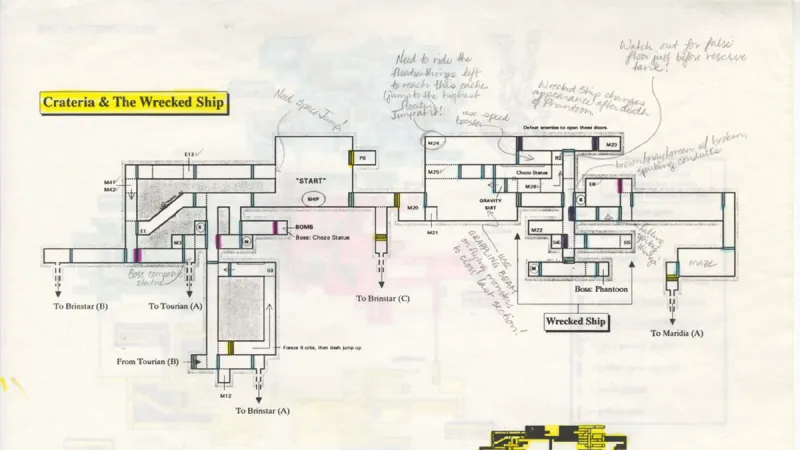
Super Metroid map hand drawn by GPCs to aid callers. Stephan Reese/Arts of Nintendo Power
While Nintendo didn’t require any of its counselors to actually enjoy games, once a person made it past the initial temp interview, it did require a weeks-long training process. Before they were allowed to take calls, new employees needed to learn how games work, their chokepoints, and secret ways of doing things.
“Instead of just answering one very simple question about Legend of Zelda, maybe you have to list all of the treasures in all of the dungeons in both quests,” says former counselor Caesar Filori. “How do you get to the minus world in Mario? What are the coins you will need to get an additional life? They just wanted to make sure you actually knew the games inside and out, and the mechanics and how to beat the bosses.”
“But I’ll be honest with you. Myself, and a lot of people at that time, we cheated through the test,” Hudson admits. “Because I was like, ‘There’s no way I’m gonna remember all this s—.’”
The new counselors were given a brief shadow period during which they would take calls while the experienced counsellor waited. Finally, they got on the telephone. There were many calls and they came quickly.
It’s hard to nail down exactly how many calls a counselor would get on a given day, though most approximations land around 100 per shift. The call center was staffed with a few hundred employees who took calls 24 hours per day at its peak. The call center received thousands of calls each day when it was open, even though 100 calls are taken per day by each individual. Sam Hosier III, who worked there between ’94 and ’97, says at one point Nintendo gave out a shirt “that said we had done 28 million calls.”
The holiday season saw people all over the country getting new Nintendo gaming consoles. The counselors dubbed this “Hell Week.”
“When we had our full call center, they put up these telecaster boards that showed you how many calls were in-queue,” former counselor Yvette Kirby Waters says about Hell Week. “We called it the ‘Hellecaster’ because you could feel the pressure when 100, 200 calls are in-queue – 300, you know? And there were over 100 people in the call center taking calls one after another – boom, boom, boom. And yet, the queue list is still in the hundreds.”
Even though Nintendo required a certain level of memorization and expertise, it was understood gameplay counselors couldn’t know everything every one of those millions of callers inquired about. Each counselor was equipped with a large, green binder containing notes, maps and other solutions to help them deal with difficult calls. Passive conversation is not enough to make a difference. A counselor would quickly turn through pages trying to find the answer. This person might be interpreted by them to be the all-knowing Nintendo Gamer that Nintendo is trying to sell them. Nintendo Power. In each issue, individual counselors were highlighted in the “Counselors’ Corner,” featuring tidbits such as their highest game score and favorite Nintendo games, letting callers put faces to the voices on the Nintendo Power Hotline.
Despite the sheer number of calls, as every counselor we talked to tells it, after long enough working the phones, you start to identify the most common questions across Nintendo’s most popular games. Although they may have received over 100 calls per day, most were for the same games. If you work there for long enough, your entire day can be spent on autopilot.
“Once you heard the question, the response coming out of your mouth, you really didn’t have to think about it,” Hudson says.
This left gameplay counselors a lot of time to play video games on the clock – somewhat making good on the dream kids had that these were people who got paid to play games all day. The Nintendo office had a growing library that contained every game released by the company up until then. “There were no gaps in the collection,” Hosier says.
Counselors had the ability to check out different titles and could even use their desks for games and calls.
“One of the risks that you have doing that is if you’re someone who emotes when you die when you play a game, that can become problematic,” Filori says, adding employees got good at muting the call. “I don’t remember who it was, but I do know for fact a time where somebody got the mic button muting reversed, so all the person heard on the other end was profanity.”
There were many famous pictures of counselors gaming at work. While, ostensibly, letting counselors play games on the clock was so they could stay up-to-date and familiar with all Nintendo’s games, these photos worked double-duty as great recruitment tools. Counselors could be seen in an office cubicle earning money or playing games with kids. Who wouldn’t think that was cool?
“The concept of gameplay counselors back in the day for a kid obsessed with Nintendo games was kind of this dream job,” Phil Theobald, who called the hotline as a kid, says. “In my head, I had this vision of gameplay counselors as, like, the best job in the world.”
There were, however, the “nightmare calls.” For example, The Goonies, based on the movie of the same name, released by Konami in 1986. Filori says that most areas of the game were identical, making it nearly impossible to pinpoint where the player was. The same with Legacy of the Wizard. HAL Laboratory’s 1989 puzzler Adventures of Lolo was another pain point for gameplay counselors.
“I mean, these are like the Candy Crushes of the time,” says former counselor Casey Pelkey about Lolo. “People would call, and they’re in, like, the 11th level or something like that. They’re like, ‘Give me step-by-step.’ And we’re talking block by block how to do something. It can take forever, and as soon as they do something wrong, it’s a reset, right? Let’s try it again.”
“Lots of people would hang up on those calls,” Filori says. “Then, because the supervisors could still hear what you’re saying, even once you’ve wrapped up [since they would monitor calls for quality]They would keep on talking. They’d hang up and keep talking and then say like, ‘Um, are you still there? Do you remember me? Hello? Hello?’”
King of the Castle
The King of Castle
Jack Sapperstein, a vacationer on St. Thomas Island in 1989, got into trouble with a boss of The Final Fantasy Legend. Despite the long-distance charges required to call the Nintendo Power Hotline, Sapperstein, who grew up in New York City, says his parents generally understood when he asked at home to call “the Nintendo people.” However, in hindsight, he admits calling from the Caribbean was a bit outrageous.
Sapperstein was one of the millions of kids who bought into Nintendo’s marketing around gameplay counselors. Sapperstein believed these game-loving gamers were the all-knowing ones who knew everything and could resolve any problem without hesitation.
“I just always felt like it was so official, and they were always kind of getting these answers off the top of their heads,” he says. “As if I was talking to Mario himself.”
He called. He was very grateful. He wasn’t just stuck on the games. Sometimes Sapperstein called with impossible questions – like how to unlock Vega on the Super Nintendo port of Street Fighter II. He wasn’t alone. Ben Rico, a San Francisco Bay Area native, has called the Hotline many times. Rico said he felt certain that there was another way. Rico called the gaming counselors in an attempt to confirm his suspicion.
“I was sitting there, like, ‘There’s gotta be a way to not automatically get sucked into it,’” Rico says. “Because I was, you know, a f—ing 9-year-old kid. Perhaps I could have been 8. The gameplay counselor – very nicely to this little kid – said that ‘No, there’s no way to do it. You get sucked in; you have to go to the next level.’”
Saperstein and Rico are what gameplay counselors refer to as “regulars.” While the Hotline did require long-distance charges for anyone outside of the Redmond area code, that didn’t stop people from calling so much that counselors began to remember them – somehow standing out among the thousands of other people they talked to every week. These were sometimes just individuals who needed someone to talk to. Some of these people were hated by counselors and fearful calls. But in even more cases, they were just kids, entirely beside themselves with the idea of talking to their heroes – people that worked at Nintendo.
The Nintendo Power Hotline’s years of operation coincide exactly with Nintendo’s rise in pop-culture prominence and the video game industry’s in general. People were increasingly playing video games and this service was created to help them. The Hotline received a large number of calls from young boys, however, our contacts revealed that people from all walks called it.
“There were some grandparents who were passionate about this,” Waters says. “Maybe they started as a way to play with their grandkids, but they really got into it.”
The importance of talking to that many people – and more importantly, that many Nintendo fans – was not lost on founder and then-president of Nintendo of America Minoru Arakawa, who impressed upon counselors that they were providing a service for people who loved Nintendo. They were important because they treated them with patience, kindness, and respect. They were, admittedly, a great marketing tool.
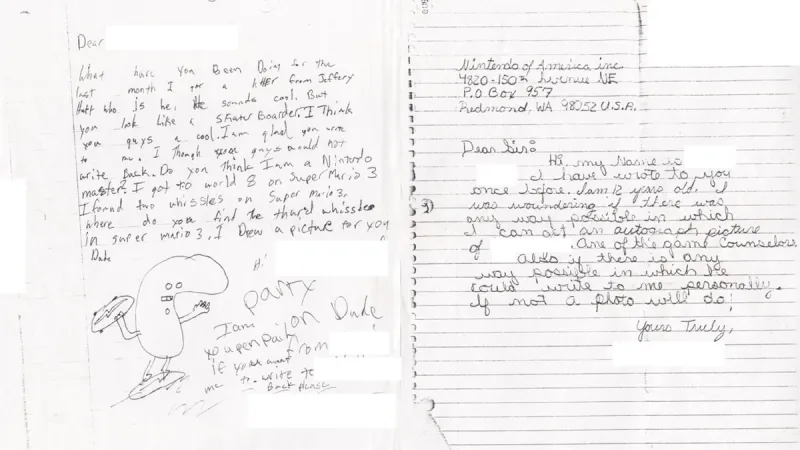
Write to Nintendo Power Hotline. Photo by Stephan Reese/Art for Nintendo Power
“Mr. Arakawa, I remember him conveying to us through the managers that this is how we make this business successful,” says Pelkey, who later worked as VP of marketing at the Tetris company, where Arakawa served as president until 2013. “If we don’t get people through the games, then they’re not going to want to buy the next one.”
Arakawa is a person people love and respect more than most executives. A lot of the people we interviewed for this piece were teenagers or young adults when they first joined Nintendo – the call center was their first job, and of course, it was an entry-level one. Arakawa, his managers, insisted that anyone who puts the effort into becoming a gameplay counselor would be able to progress towards a position within Nintendo. It didn’t matter how low someone was on the totem pole or what department they worked in; there was always room to go up at Arakawa’s Nintendo.
“He was a very kind, generous, man,” Hudson says. “I mean, what other CEOs knew every single employee’s name?”
It is probable that Arakawa was affected by this generosity at least two or three times.
For a brief period and in the ’80s and ’90s, Nintendo spared no expense when throwing its annual holiday party. It would rent out entire floors of luxury hotels in downtown Seattle, offer hotel rooms and limo rides to and from for every employee so they wouldn’t need to worry about finding a sober driver, and give them top-shelf food and drink. Nintendo invited every employee – not just its C-suite. The parties were described by former counselors as inspiring. The problem was that the group consisted of many young males in their 20s and teens. Once alcohol started to be involved, it quickly became a mess.
“I do know some stories of people – whose names I can’t remember, and it’s probably good that I don’t – who lost their job after a Christmas party because of inappropriate behavior and apparently actually broke an elevator at the Sheraton in Seattle,” Waters says. “I don’t know how you do that. Perhaps they put too many people on the elevator. [they] managed to get an elevator stuck.”
“They ended up having to stop doing that,” Hudson says about the holiday parties. “They were destroying these rooms, and Nintendo was hearing about it from the hotels. That only lasted a year or two before they put a kibosh on that, too.”
The culture at Nintendo and the call center were positives in the opinion of everyone we interviewed. However, with 30 years of hindsight, Waters does admit the culture probably wouldn’t be acceptable by 2022 standards, likening the call center office to a “college dorm.” It was also majority white and majority male. However, she does point out that her team – the bilingual call center employees, which served Spanish-speaking callers and French Canadians – was largely female.
“In the call center, there was a lot of things probably going on that I would say people would recognize now as inappropriate. It was fun at the time. [thing where] this organization was established by young people,” she says.
“So, you know, there’s some things you look at now and go, ‘Woah,’” Waters adds, laughing.
Hang Up
Hang Up
From 2005 to 2005, the Nintendo Power Hotline was in operation. It was a major part of Nintendo of America’s day-to-day business. In the end, the green binders became obsolete and were replaced by an Electronic Manual Organizer (ELMO) computer system. This made it easier to look up information and find answers. However, the technology eventually ended the need for gaming counselors. If every walkthrough is easily accessible online – for free – why would you pay to call the Hotline? It was especially after the Hotline switched to a tolled, 900 number from its Redmond area code.
But if there’s one thing that stands out and one thing that makes it unique, it’s that it’s remembered at all. There are numerous other call centers in the world, few of which have any longstanding legacy – much less any as fondly remembered as Nintendo’s.
The call center was primarily focused on playing fun games. Arakawa also required that call centre employees be friendly to all who called. He also required all letters sent to Nintendo of America receive a reply; an entire staff was dedicated to handling mail. In terms of customer service, Nintendo was the clear winner.
Stephan Reese, who’s dedicated his life to collecting Nintendo ephemera and runs the Art of Nintendo Power education exhibit, describes it succinctly: This was the first time many people had taken their hobby seriously. It was the first time people didn’t talk down to them about liking video games.
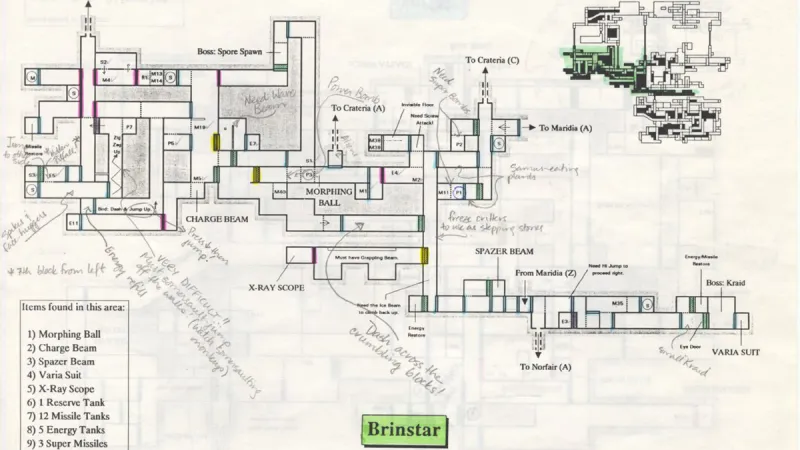
GPC annotations on a map of Super Metroid’s Brinstar area. Stephan Reese/Arts of Nintendo Power
“It really was a friend for a lot of these kids,” says Reese, who called the Hotline once when he was around 7. “Specifically, a friend who spoke their language, who knew what they were talking about, who loved games as much as they did, and was able to articulate that back.”
“These were the only adults in my life who were not openly mocking something that I love more than anything,” Reese adds.
Counselors who were interviewed for this job had to first go through the call centre before they could join the industry. Waters worked later on the Nintendo GameCube’s software development kit, before she moved on to Microsoft. She’s now a self-employed contract strategist. Before joining T-Mobile, Hosier was an assistant manager and event producer at Nintendo. Filori started his career with Nintendo as a test engineer. He later went on to work for EA and Microsoft. He’s now a technical programmer at Meta. You can go on and on.
For all, however, the call center was where it began for them all.
“Sometimes you hear about something being this golden age, right?” Filori says. “It felt like a golden age at the time. It’s different. It’s something new; it’s different; this is a unique thing. I don’t know that it could ever be recreated or replicated to be part of the explosion of video games at the time.”
“It was weird,” he adds. “It was a very weird and unique thing.”
The original publication of this article was Issue 343Game Informer.
#Nintendo #Power #Hotline