House of the Dragon episode 8 review: Every wound is festering
An eye missing, a broken tooth, or a scarlet-thin mark that is visible against pale skin. So much of “The Lord of the Tides” is structured around the injuries House of the Dragon’s cast have accrued throughout their troubled lives. Even the title incident of a succession crisis in House Velaryon is set off by Lord Corlys (Steve Toussaint), who suffered a severe wound during battle. We never see the wound; in fact, Lord Corlys doesn’t appear on screen at all, but knowledge of it sets into motion a struggle for power that costs a man his life and sets the royal family once more at each other’s throats. Think of it like Laura Palmer’s absence in Twin PeaksThe kind of vacancy that leaves behind a lot of negative space and creates new stories.
This is a family that can’t stop hurting itself, and nobody has suffered more in that regard than King Viserys (Paddy Considine). However wrong he is to cling to the hope of an impossible status quo, however deluded he is as to his power to make the people he loves accept peace, it’s agonizing to see him so diminished, his body skeletal and sunken, covered in open sores, his mind addled by the opium tincture known as milk of the poppy. Even drawing breath, he’s as much a wound in the fabric of the kingdom as Lord Corlys.
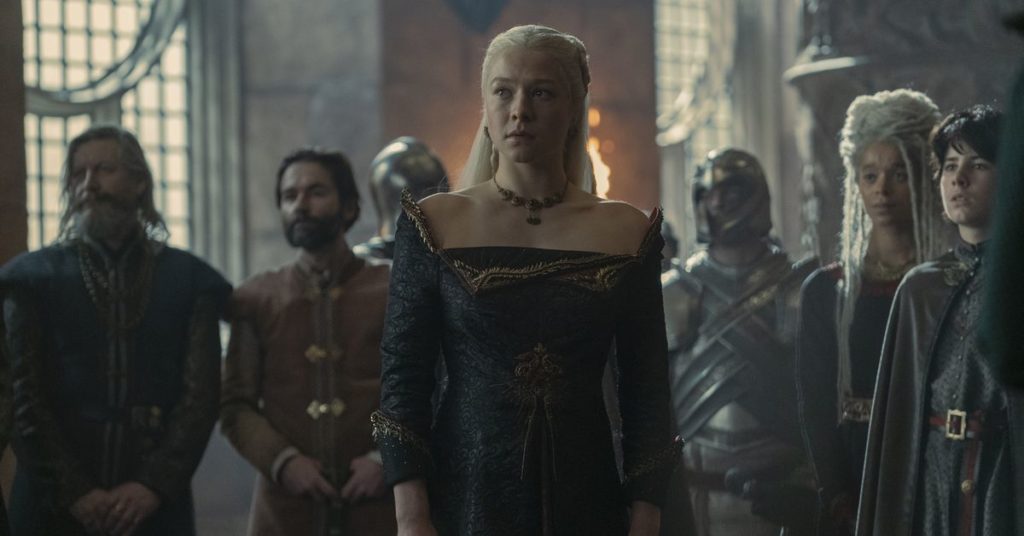
Emotional wounds that are exchanged across the division between the two courtsly camps can be as pervasive as physical ones. When Rhaenyra (Emma D’Arcy) first sees Alicent (Olivia Cooke) upon returning to King’s Landing after a six-year absence, her hand flies at once to the scar on her forearm, mirroring a later scene in which she and Alicent clasp hands with apparently unfeigned warmth. Alicent rubs Rhaenyra’s arm and wrist as though in apology, and for the first moment since the time skip it seems as though some flicker of the romantic spark that animated their shared childhood could be reignited. Cooke and D’Arcy have an immediate chemistry strong enough that even the knowledge that this rapprochement is doomed can’t dent the exchange’s power. Their showdown in the Red Keep’s throne room is equally charged, the whole of the court looking on as they air their dirty laundry with ever-mounting venom. Rhaenyra’s open outrage is captivating, D’Arcy’s hawkish, aristocratic features perfectly suited to the towering contempt of a princess who’s never had to play petty games and so finds repellent the half-truths and evasions by which Alicent conspires to strip her sons of their inheritance.
:format(webp):no_upscale()/cdn.vox-cdn.com/uploads/chorus_asset/file/24091779/rhys_ifans_olivia_cooke.jpg)
Photo: Ollie Upton/HBO
Viserys is insistent on going to the royal meal despite his increasingly declining health. He removes his gilded mask that he wears in court to cover the lesion below the muscle. He asks his family not to view him as their King, but rather as a husband/father/grandfather. His social strategy is the horrific sight of his wounds as an indisputable reminder of his mortality. Considine’s wound and his old-age makeup look amazing, and avoid rubbery latex skin or unconvincing CGI. Considine looks nothing like a medieval leper. He is ensconced behind his neglected study in a vast canopy, where he used to labor so joyfully over the model of Old Valyria that’s now covered with cobwebs.
Another structuring absence is the ancient freehold. It’s also the source of dragons royals seek and bloodlines that they use against each other to dispute claims for legitimacy. This practice has a certain etiquette, which is based on invoking the absences of Rhaenyra’s sons and not naming them. When Vaemond Velaryon (Wil Johnson), chafing against the obvious lie of the parentage of Rhaenyra’s sons, dares to move past innuendo and into accusation, the dangers of probing at such a wound with one’s fingers swiftly become apparent.
Ironically, it’s only after Vaemond’s death that we see him treated with any tenderness. The silent sisters prepare to embalm the arrogant and abrasive man, with his severed head held in reverent line by them like something from the future. Hellraiser. We revere and memorialize our wounds because to admit they’re meaningless is to confront our own powerlessness, our insignificance in the face of entropy. And as Viserys draws what may be his last rattling, anguished breath, it’s hard not to think that his life of pain will become just another wound his descendants and widow can’t stop picking at, another absence into which they’ll project their own meaning.
It’s like the serving girl Diana, who at the episode’s start is presented shaking and in tears to Alicent, where she recounts her experience being raped by Prince Aegon. Alicent gives her fake sweetness and comfort. Then she hush money. You can close that wound. Pretend you haven’t got it anymore. Except that once it’s dealt, it’s already too late. You can’t stop tonguing the hole where your tooth used to be. You can’t stop picking the scab. After this week it seems all of Westeros’ wounds are on the verge of being torn wide open.
#House #Dragon #episode #review #wound #festering