Exploring Shibuya With Tango Gameworks

Introduction
It’s a section of sidewalk that you could easily walk by and not even think about. It’s a 15-foot patch of concrete the same as the 15 feet ahead of you and the 15 feet behind you. It’s the same as what you see 100 feet ahead. It’s nothing.
You can’t see the future unless you stop looking around.
You will find map coordinates to most of the landmarks visited in this article. To see a street view of our route through Shibuya, click the links
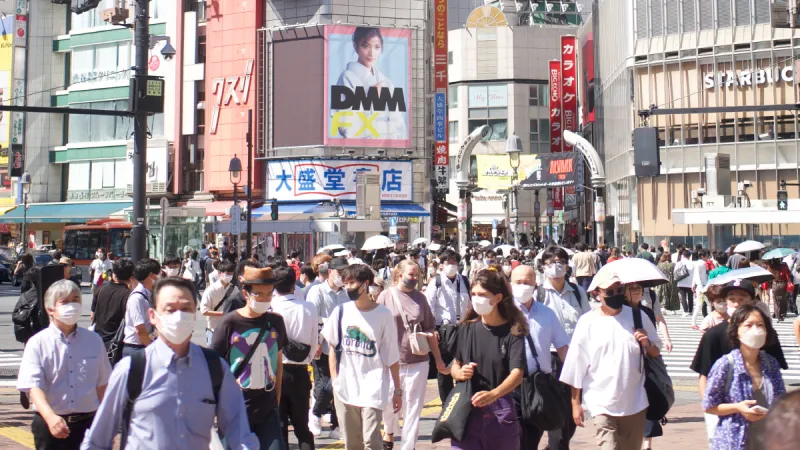
I’m standing in the Shibuya ward of Tokyo, Japan, which, if it’s famous for anything, is its crosswalk, Shibuya Crossing, a massive scramble intersection allowing foot traffic to cross in all directions. For lack of a better analogy, you could call it Japan’s Times Square. You’ve seen it in everything about modern Japan ever.
Shibuya Crossing (35°39’34.7”N 139°42’02.1”E) feels like the future. Hundreds of people – maybe thousands, depending on the time of day – all walk at once while massive, animated billboards blast light and sound in every direction. Skyscrapers dominate the skyline – some no more than just a few years old, and plenty more being built all around. One of the world’s nicest, cleanest, and most modern subway systems takes millions of passengers to and from each day. You can find every convenience and vice that you need within a short distance at any time.
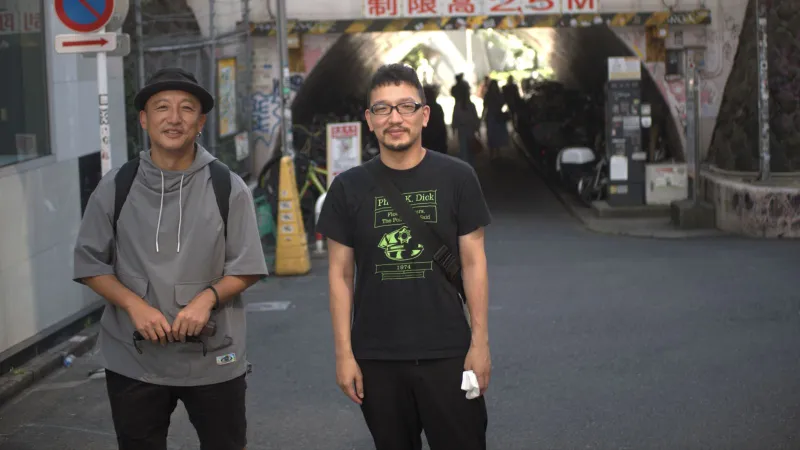
Masato and Kenji (left)
But I’m not there; I’m a block away, standing on this boring patch of sidewalk (35°39’37.5”N 139°42’03.3”E), seeing the past with Kenji Kimura and Masato Kimura (no relation), a director and producer, respectively, at Tango Gameworks. We’re looking down a connecting alleyway at an old tunnel allowing pedestrians to walk under the train lines. It’s full of bikes, covered in graffiti, and especially compared to all the high-end shopping on the other side of the street; it looks remarkably old and dingy. It’s captivating. Here’s a look at how this area used be decades ago. (The earliest photo I found is from 1951). Before the modern world arrived, it was fascinating. This tunnel has remained the same, regardless of what reason.
Kenji and Masato helped lead the development of Tango’s most recent release, Ghostwire: Tokyo, an open-world game based in Shibuya. The tunnel, which is located a block away Shibuya Crossing in the game, looks exactly like it does in real life. Ghostwire isn’t a horror game, but it is spooky, dealing with the supernatural and the weird. The juxtaposition between old and new is what makes Tokyo so attractive.
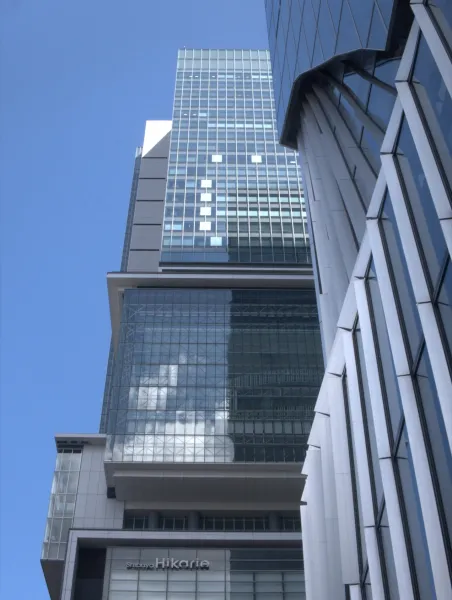
Shibuya Crossing is home to new skyscrapers such as Shibuya Hikarie (pictured above).
“That’s the ordinary world; that’s the unordinary world,” Kenji says, pointing at both sides of the street. “They’re so close together, but the appeal is in the unordinary that sits so close to it.”
Masato adds to Kenji’s thoughts, saying, “It’s that spookiness. It’s that mysteriousness, you get from the unusual side. […] when it’s so close to the ordinary like this.”
For the next few hours, Kenji and Masato are my tour guides through Shibuya – from the flashy lights and loud sounds to the hidden temples and seedy backstreets, they show me the vast contrasts of the area, telling me how it all made its way into Ghostwire.
It all begins with the first step through the tunnel into the extraordinary.
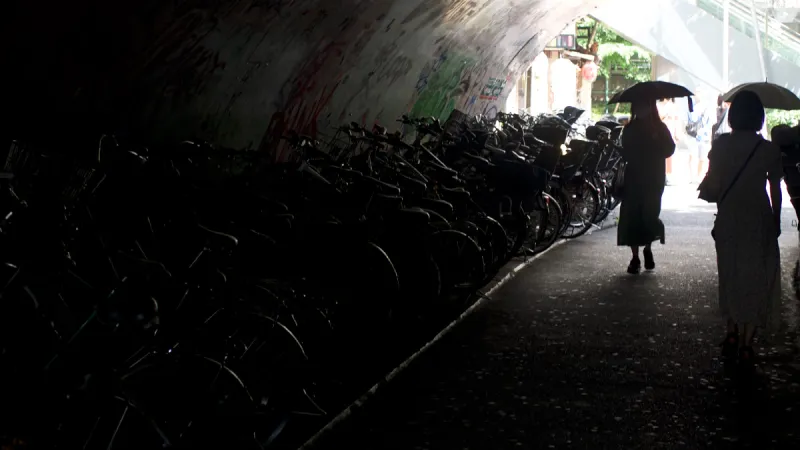
You can find the old tunnel nestled in between modern buildings.
Hidden away
Hidden away
On the other side of the tunnel, we find ourselves in the post-war Showa Era, in Nonbei Yokocho (35°39’36.6”N 139°42’05.3”E), or “Drunkard’s Alley” – which is actually two alleys, but nevertheless. Nonbei Yokocho is an area with many small bars that are packed together in long narrow buildings, often sharing one roof. Notably, the bars are so small (only allowing a few customers at a time) that they don’t all have bathrooms. A handful of small bathroom stalls are along the alley’s streets.
Nonbei Yokocho’s history dates back to immediately after World War II when food cart operators set up their stalls in the area. In 1951, the tenements I’m currently looking at were built when those operators were given small 100-square-foot pieces of land. Nonbei Yokocho is home to a handful of bars, but there have been patrons coming here for many decades. The area was honored with its 70th birthday in 2021.
Nestled tightly between the train tracks and all of the high rises and redevelopments engulfing it, Nonbei Yokocho feels like the past hanging on for dear life – even if, as Kenji points out, parts of the surrounding area have already been lost to time.
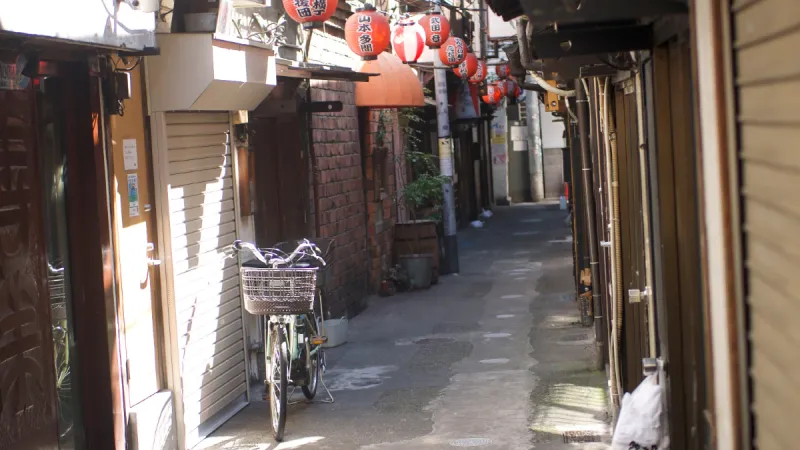
Nonbei Yokocho
“The city changed so quickly while we were developing [Ghostwire Tokyo],” he says before turning his attention to the neighboring redevelopment, which used to be an outdoor park area full of trees and bike parking. Now it’s the entrance to a shopping mall. “It used to be big; it used to go all the way down here. […]Because construction was going on and on, we had to make a lot more changes. It’s the same with the train station, too. The location of the ticket gates was changing constantly.”
Tokyo’s major cities are undergoing rapid transformation. Many historic and famous landmarks like Harajuku Station, Nakagin Capsule Tower and Harajuku Station have been demolished to make way for new buildings. In Japan’s specific case, there is a fairly good reason to tear down old buildings; the nation experiences more earthquakes than any other country. Over the past few decades, laws have required that new buildings comply with stringent guidelines to remain structurally sound in major earthquakes. It’s hard to imagine Nonbei Yokocho’s old bars staying intact through an intense earthquake; it’s probably safe to assume the buildings here don’t meet the most recent requirements.
Nonbei Yokocho’s neighborhood cooperative is not unaware of the importance. Shigeru Muramayama, head of cooperative told The Japan TimesMany developers tried to purchase the land in 2015. He received many calls during 2015 They have been able retain a small part of Shibuya’s history because the cooperative is the owner of the land, which keeps individuals from being taken out.
According to him, “But, we’ll eventually have to think about tearing it down so that we can pass the yokocho (alley), culture on to the next generation.” We have a responsibility to make sure that the yokocho is rebuilt in a way that will be safe for future generations.
Japan is slowly losing parts its historical physical heritage. It’s time to adapt with times and decide what bits of the past you want to let go. However, in 2022 areas such as Nonbei Yokocho will still be present, creating a curious mismatch between past & present.
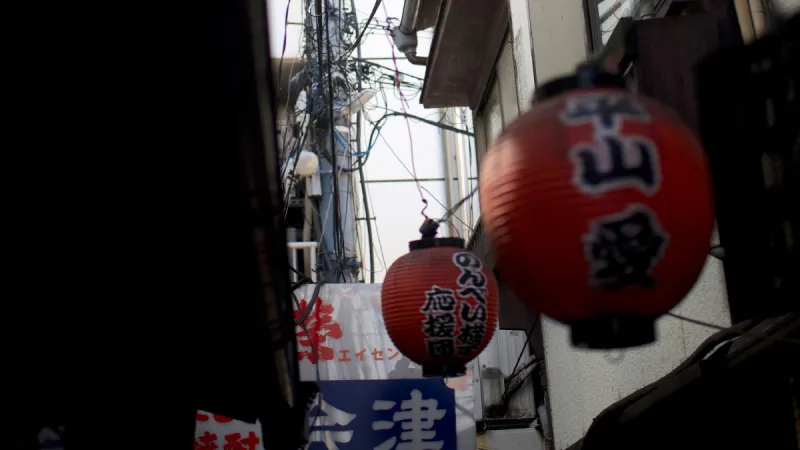
Nonbei Yokocho
“It’s not very planned out, ‘This section will be new, this section will be old,’” Masato says. “It’s just the way the different mixed pieces are glued together [that] makes Tokyo feel like it’s welcoming to all these different ideas.”
To that end, when creating Ghostwire’s world, the team decided not to make a carbon copy of Shibuya. Of course, Tango created certain parts one-to-one, but as Kenji tells me, most of the developer’s philosophy was finding ways to create a game world that felt representative of all the different flavors of the area. To cut down on having to constantly remake portions of the game’s map as new things were built around the city, Tango set Ghostwire in August 2020, creating an artist’s rendition of that specific time and place.
“We gave up on making a complete copy of Shibuya very early,” Kenji says. “Instead, we thought about how to make it more distinctive and interesting in our way. To deform it in a way that’s more interesting.”
“People in Japan seemed to have caught on [to] the distinctive portions of Shibuya that we were able to create,” he adds. “People would recognize those and say, ‘Hey, that is Shibuya! That feels like Shibuya.’”
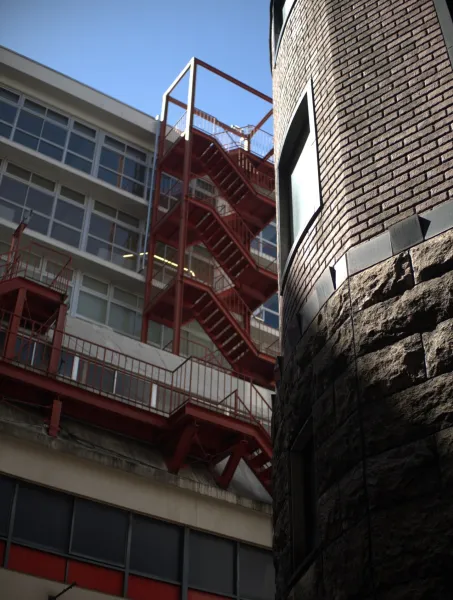
“It makes me want to climb up there.”
As we walk on from Nonbei Yokocho, exploring the neighboring modern sidestreets and alleyways, a large red staircase at the back of a bowling alley stops Kenji in his tracks (35°39’36.4”N 139°42’11.0”E). The places you can’t go in Shibuya are the most appealing for him and the Ghostwire team.
“It makes you want to climb up there,” he says. Masato backs him up, adding vertical exploration was one of the pillars of Ghostwire’s development. Tango considered how it could utilize the city’s real-world architecture, incentivizing a desire to explore. You can do it in the game. Real life is different. We can walk straight on and not stop at the top.
“It’s those kinds of locations that you walk by,” Kenji says. “It does tickle your curiosity; it does make you want to go in there. But you can’t in real life because, in kanji, it says ‘Employees Only.’ If it’s a game, you can.”

Fan blocking the second-story door to the outside
A second oddity prevents the two from walking. There is an alley between the two office buildings that is small enough to be walked through. The second floor has a door which leads outside. But using that door, at best, would be a massive inconvenience (35°39’36.3”N 139°42’11.7”E).
[Editor’s note: This one takes a bit of work to find, but changing the street view date to Nov. 2009 should get you there.]
“These are just crazy,” Kenji says. “There’s a ladder there to a small door that has an air conditioning fan just blocking the door. This might seem like a bug in the game to make such an architecture. But it’s in real life!”
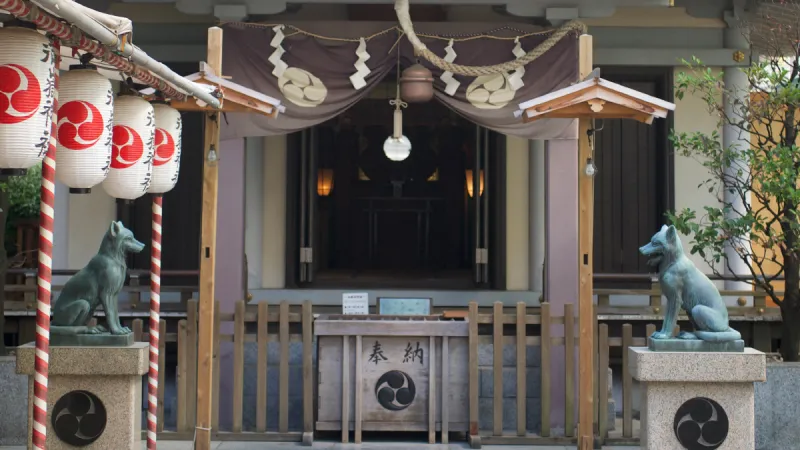
Miyamasumitake Shrine
We end the first half of our tour at Miyamasumitake Shrine (35°39’35.4”N 139°42’13.9”E) – believed to have been built between 1673 and 1681. It is located on top of a tall staircase that runs between two skyscrapers. A post office, a hamburger place and a massage therapist are its nearest neighbors. Shibuya is an astoundingly loud place; there’s the normal city traffic, but also speakers constantly blaring music and advertisements. But up here, just feet away from the chaos on the street below, it’s almost completely silent. Each of us has the chance to take a few moments to reflect and to communicate with each other in a reasonable volume. Close your eyes and you might forget about the many people around you.
It’s a nice place to stop and catch our breath before stepping back into the chaos.
About Town
About Town
In Shibuya’s Mark City building is Okamoto Taro’s 98-foot-long painting “Myth of Tomorrow,” depicting the moment the atomic bomb struck Japan during World War II. It’s a portrayal of fire, death, and destruction. Per the Taro Okamoto Memorial Museum’s website, it’s also about “proudly overcoming even the cruelest of tragedies and giving birth to ‘a myth of tomorrow.’” It sits just feet from Shibuya Crossing. It is a stark contrast between death and rebirth, juxtaposed with high-end shopping and Boba Tea. It’s no less chaotic.
“For me, it’s not a political message that I take from it,” Kenji says. “I take the power and energy that this artist is trying to express. I try to receive that power so that I can output the same.”

“Myth of Tomorrow” by Okamato Taro, located within Shibuya’s Mark City building
Kenji said that he came here to replenish his energy. When he first started work at Tango on Ghostwire, he came here to receive Okamoto’s energy. I’m not sure I personally receive any particular energy from the painting, but it is undeniably striking. We’re in a shopping mall effectively, but the massive piece steals your attention. It’s difficult to see anything other than the intricate colors and shapes. It takes me far too long to notice the hundreds of people trying to shuffle around us as we all stand in the middle of the walkway staring up at “Myth of Tomorrow.”
This is Kenji’s first time back to the painting since the game was released. Standing here, looking at Okamoto’s masterwork – once thought to be lost in its original home in Mexico in the late ’60s before being brought to Japan and restored in 2005 – I ask him how he feels.
“It makes me feel like I want to do something new,” he replies. “I want to do the next thing.”
We, too, are onto the next thing – seeing the greatest hits of Shibuya landmarks that inspired Ghostwire.
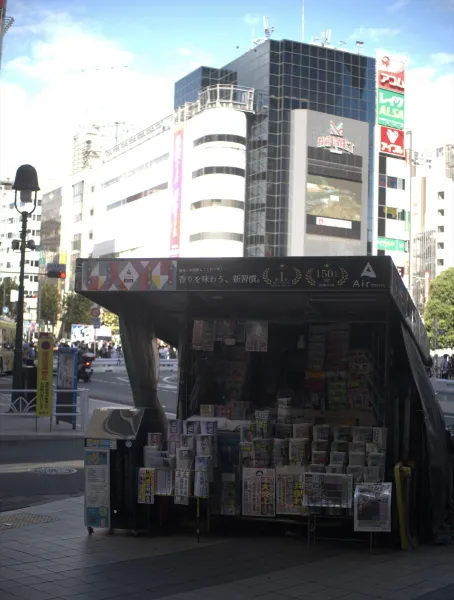
This newspaper kiosk in Shibuya Crossing showed up in Ghostwire: Tokyo as one of the nekomata item shops
We depart and we enter Shibuya Crossing’s sea of people. Kenji points out a small newspaper kiosk (35°39’32.4”N 139°42’00.5”E) directly outside of Mark City – an apparent hot spot for local graffiti artists. The old and messy appearance makes it stand out against the new shiny exterior of everything else.
“This kiosk here is very Shibuya for me,” Kenji says as we walk by. “Even in the game, I felt that this shop should be exactly right here because it’s so iconic. That’s why we have a nekomata store [there] in the game.” (The nekomata are the floating cat yokai that run Ghostwire’s in-game shops)
Kenji, Masato and I glide effortlessly through foot traffic while they pass me like a white man visiting a foreign nation. It is difficult to visualize this many people moving at the same time unless you are actually there or reside in a relatively small city. My home is in Minneapolis, Minn. so it’s completely foreign to me. Everything is so organized, even compared to the place we come from.
Despite Tokyo’s size and the fact that it’s one of the world’s more documented, photographed, and recorded cities, people here are strict about when and where you can take pictures. More than once on this trip, I get yelled at for taking pictures of something that wouldn’t be a big deal anywhere else. All over the place, signs banning photography can be seen. If you watch Japanese YouTubers filming outside, you’ll notice the great lengths they often take to blur the faces of people walking by (it’s easier these days since everyone is wearing a mask due to the ongoing pandemic).
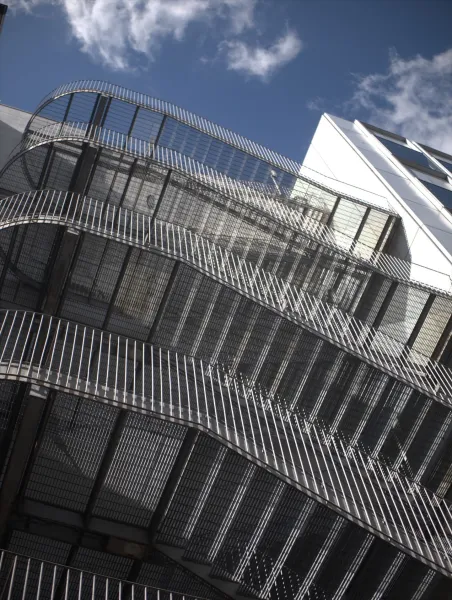
A staircase Kenji Kimura says had to be in Ghostwire: Tokyo
Ghostwire was unable to capture this reference material. Developers often take photos of the real world to which their games are set when creating a game. At best, it can draw the ire from those around you. “They would stare at us in a very bad way,” Kenji admits.
Ghostwire’s specific take on Shibuya also created some unique challenges for gathering reference material. Akito is the protagonist, while Shibuya has the other characters and the yokai wandering about, but the city of Shibuya appears completely empty. Standing here, it’s hard to imagine this place with nobody on its streets. The Tango team came up with creative solutions.
Masato told me the streets look empty just before sunrise. The team would come here to try and replicate Ghostwire’s empty setting as best it could. Kenji adds that the sound team would also come here in the middle of the night to capture Shibuya’s ambient sounds.
They point out additional landmarks in Ghostwire as they walk along. There are obvious spots, like the Shibuya109 (35°39’34.6”N 139°41’57.9”E), a famous mall full of department stores catering to youth fashion. “It’s difficult for older men to walk into this building,” Kenji says, making Masato laugh. And the TOHO Cinemas Shibuya (35°39’33.5”N 139°41’55.1”E), which just barely made the cut. “We didn’t have it in the game initially, but we felt not having a movie theater there didn’t feel like it was Shibuya,” Kenji says. There are also the walkways connecting many buildings, specific streetlights, and even one exact staircase (35°39’33.3”N 139°41’53.7”E) connected to another shopping mall. “It’s very memorable; it made me feel like it should be in the game,” Kenji says.
Enduringly, the people and chaos are gone and we head down a mostly empty street with only two things that seem very different but somewhat alike depending on your perspective: sex or death.
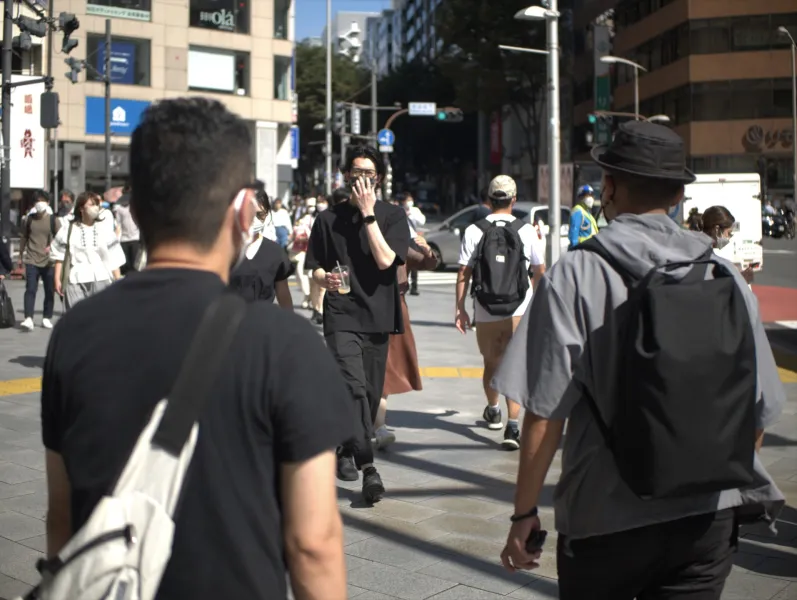
Walking around Shibuya with Kenji and Masato Kimura
As told by Tadayuki Horie, who’s accompanying us and serving as translator, there’s a lot of cemetery land around here. People don’t want to live where cemeteries are, so businesses set up shop instead. In the specific part of Shibuya where we’re ending our trip, that land was bought up for nightlife (35°39’33.7”N 139°41’46.9”E).
“Strip clubs, host clubs, hostess bars,” Horie says. “[At]Night time is a good time to not take your camera out. A lot of yakuza businesses.”
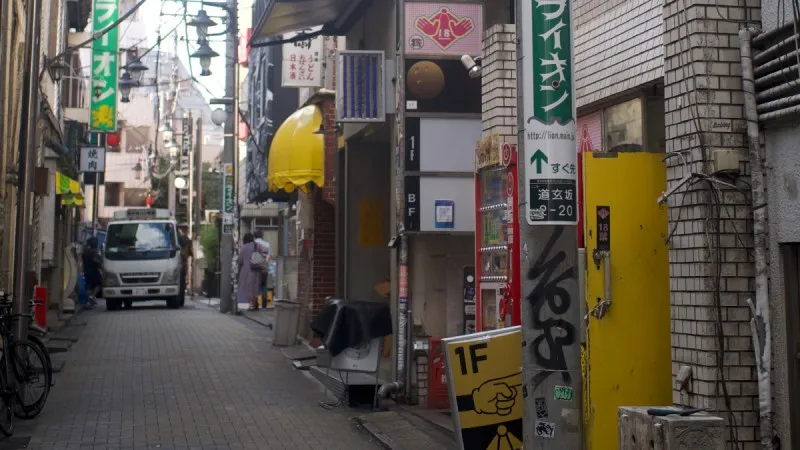
The redlight district tucked near the lights and sounds of Shibuya Crossing, with signs prohibiting anyone under 18 from entering certain establishments
We’re in the redlight district of Dogenzaka – or, as it’s often called, “Love Hotel Hill.” There are hotels where you pay for a room by the hour, seedy bars, and stores advertising underwear and “uniforms” – and that they buy “used” clothing. Kenji claims that Tango used this area for reference footage, however, as they wanted to make a Teen-rated title, the seediness of it was greatly reduced.
There are many reputable businesses here. Kenji enjoys going to shows at the music venues. It is still a small, sinful area less than half mile away from Shibuya Crossing’s massive Ikea and Starbucks. Compared to, say, Times Square, which was famously “cleaned” of all its adult theaters, sex shops, and the like in the mid-1990s before becoming a tourist trap, here in Shibuya, mainstream consumerism and back alley activity seem to live together somewhat harmoniously. However, nobody has yet been brave enough to kick the landowners out.
“The owners of the land are not the kind of people who are going to accept any of that,” Horie says.
But perhaps more surprising than all of this being just a few streets over from an Outback Steakhouse is what’s nestled right in the corner of all this sleaze: Chiyoda Inari-jinja Shrine (35°39’34.4”N 139°41’45.7”E), dating back (not in this specific location) to the 1400s.
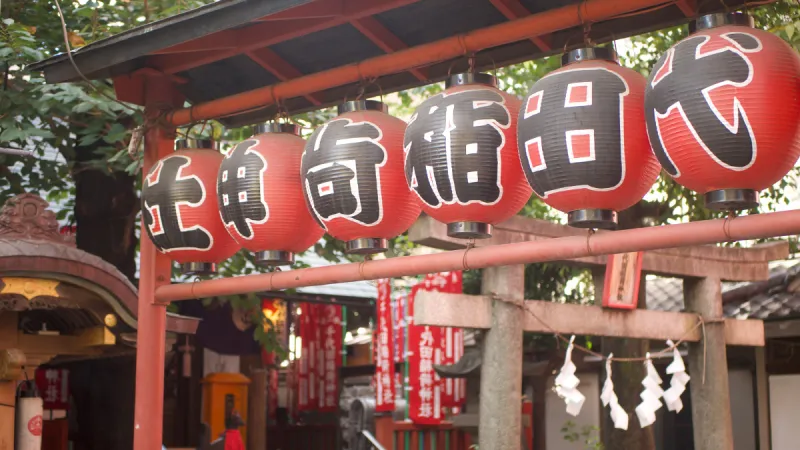
Chiyoda Inari-jinja Shrine, located deep within “Love Hotel Hill”
“There’s a sense of spirituality,” Masato says. “These shrines are definitely sacred grounds that should not be removed or reduced.”
“In most cases, there’s a sense of the old stuff within the new,” he says. “That keeps us hopeful and happy.”
Rediscovery
Rediscovery
All of the sights we visited today were within one mile. The same distance can be covered in just 15 minutes. We spent hours exploring this part of Shibuya instead, one ward within one of the largest cities in the country.
As far as I’m concerned, the tucked-away secrets in alleyways and off-the-beaten-path side streets are the most interesting parts of exploring Tokyo. Everywhere you go, there’s something to catch your interest and scratch your head over. But of course, I’m a tourist; this is all new to me. People look at their phones and overlook everything else I see.
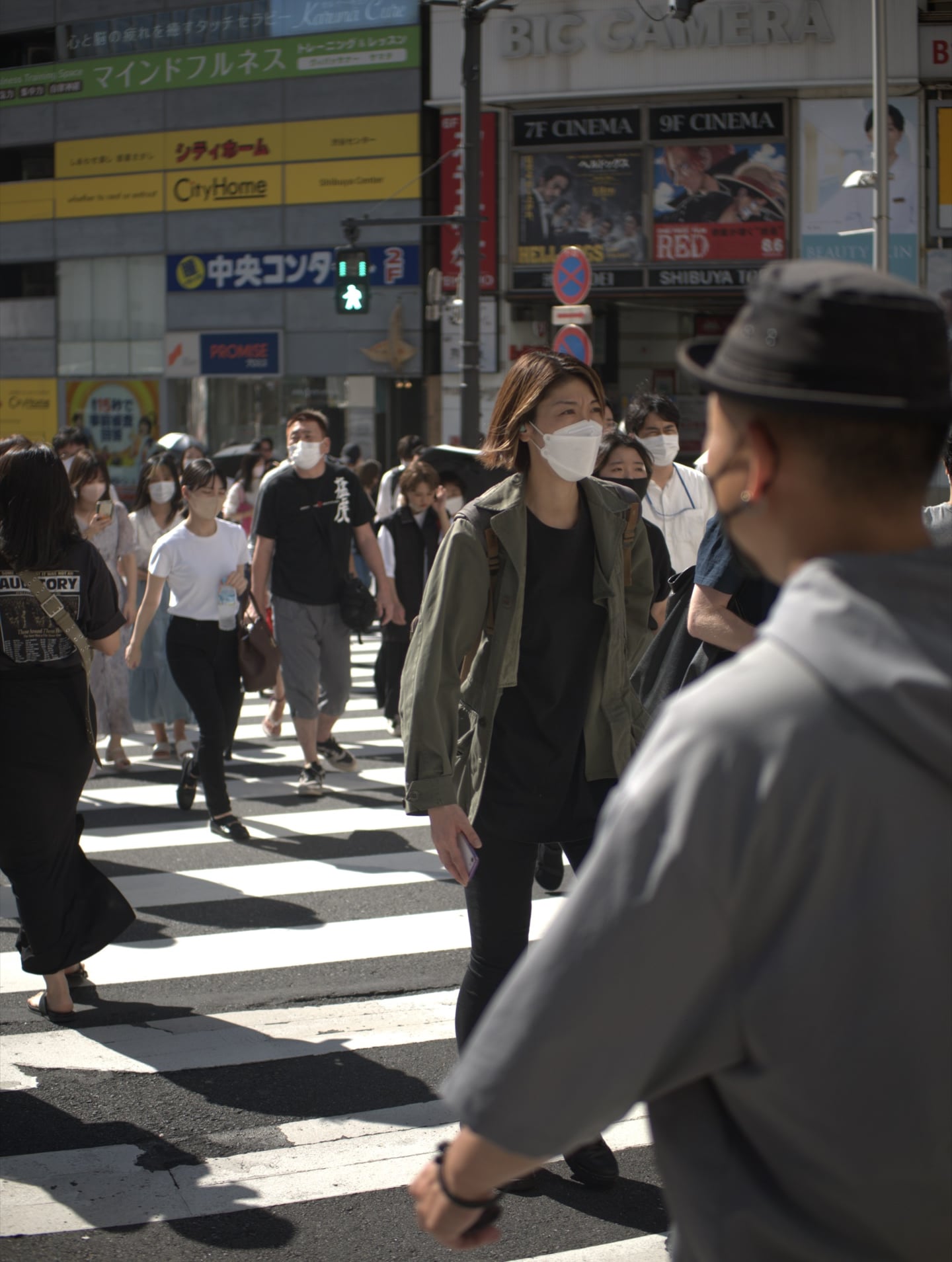
Masato Kimura strolls against the sea of foot traffic
It makes perfect sense, they see it all day. I don’t walk around Minneapolis marveling at the same Trader Joe’s I pass every day of my life, either. It doesn’t matter if your city is the greatest in the world. Once you get into a routine you lose sight of the great things about a place. Instead, your eyes begin to concentrate on the negatives. When I think about it, all those sidestreets and back-alleys would be a massive pain to navigate each day if I was on my way to work; I’m certain I’d opt for the most direct path instead, and I’d stare at my phone the whole time I walked it.
Kenji is from Tokyo originally; he’s lived here all his life. When he was a student, Kenji used to travel to Shibuya quite often. He now lives just one train stop away. He is an expert on the local area and visits it twice every week to see movies. After living in the area for decades, however, he lost sight of all its unique aspects. In order to make Ghostwire, which was a video game that celebrates Tokyo, Tango had no choice but to take to the streets and discover the places its creators had forgotten. At one point, Tango even rented a satellite studio in Shibuya while working on Ghostwire’s storyboards so it could be right next to all of the real-world locations.
My team discovered its passion for Tokyo and showed it to me. In turn, they encouraged me to visit more parts of the city. Minneapolis may be smaller and less exciting, but I’ve found dozens of unique places and neat pockets I never knew existed. There’s always something to find off the beaten path.
“When we were making the game, initially, we had a lot of those main streets – like we said, the daily, ordinary streets,” Kenji tells me. “We tried to think about what kind of cool things we could do. But when we walked around the city, it’s the smaller alleys where we felt our heartbeats go up, and we [started thinking]All the amazing things that could happen in this area. We felt these were the most exciting things so we wanted to be able to explore more. Definitely, by walking around the city, we were able to rediscover the cool things like that.”
This article first appeared in Game Informer Issue 352.
#Exploring #Shibuya #Tango #Gameworks