Nimona the movie loses a lot by nerfing the comic’s best relationship
For a longtime fan of ND Stevenson’s webcomic turned graphic novel, Nimona — someone who followed the original comic’s release week to week from 2012 to 2014, and became part of the growing fan base hanging onto each new cliffhanger and reveal — the release of Netflix’s animated adaptation is a bittersweet moment. It’s exciting that the film was actually completed and that it made it to the public, after Disney acquired the project and scuttled it, reportedly (and very believably, given Disney history) out of distaste for the story’s central gay couple. And it’s exciting to see that story, and Stevenson’s comics work, finding a larger audience.
But there’s still that lingering feeling that fans of a book almost always get when they see it adapted for TV or film. Whether the screen version is well made or not, regardless of whether it stands on its own and finds its own audience, there’s often still that forlorn little inner voice whispering, But you aren’t actually telling the story that drew people to this title in the first place.
Stevenson says the movie version preserves the most important thing about his comic — the personality, powers, and meaning behind his fiery shape-shifter protagonist Nimona. And he says the movie reflects backstory that he always wanted to put in the comic and couldn’t find a place for, and that the changes were necessary. He isn’t being cheated out of something with this highly altered version of this story. But still, as a fan, there’s one thing I miss from the book more than anything else that was dropped for the movie.
:format(webp):no_upscale()/cdn.vox-cdn.com/uploads/chorus_asset/file/24764063/FightSilhouette.png)
Image: ND Stevenson/HarperCollins
Netflix’s version, directed by Nick Bruno and Troy Quane (Spys in Disguise), and scripted by Robert L. Baird, Lloyd Taylor, and Pamela Ribon, keeps a lot of the book’s broadest parameters. In a high-tech retro-future (what Stevenson calls “monk-punk”) where knights and royalty hold sway over an easily manipulated peasantry, a knight (Ballister Blackheart in the comic, Ballister Boldheart in the movie) is wronged by his kingdom’s leadership. Nimona complicates his quest to uncover the truth. This girl has vast, unpredictable, violent powers.
Ballister is minimized in the film version, which focuses on Nimona. He’s a softer, more helpless, more easily confused character in the movie, with all his rough edges worn away. In the movie, he spends most of his time being pulled along by her screaming than attempting to do anything on his own. And in the movie, his boyfriend — a golden-haired hero-knight with the truly ridiculous name Ambrosius Goldenloin — is determined to get to the truth behind Ballister’s ouster from the kingdom as well. Ballister and Ambrosius are a cute, supportive couple who open the movie with a chaste, sweet cuddle, and who experience frustration with each other throughout the movie, but always seem to be on each other’s side.
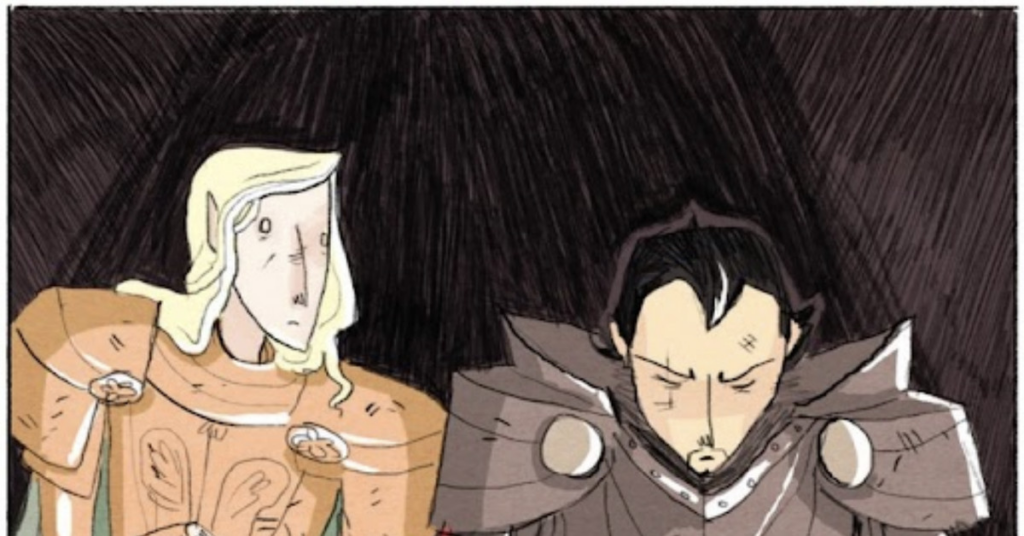
The comic centers much more on these two characters, their complicated relationship, and the roles they embody for the kingdom, with Ballister as a scheming villain and Ambrosius as the kingdom’s shining hero. The majority of critical evaluation and approval is for Nimona The focus of the comic has been on Ambrosius, the main character. He is a symbol for homophobia and trans identity. But Ballister and Ambrosius’ thorny relationship was always the richest part of the comic, and it is sad to see how much of it was swept away in the process of making this Nimona’s story first and foremost.
:format(webp):no_upscale()/cdn.vox-cdn.com/uploads/chorus_asset/file/24764070/DammitNimona.jpg)
Image: ND Stevenson/HarperCollins
Stevenson started out as a cartoonist in the early 1900s. He was a fan of comics and had a unique sense of humor. Stevenson started Nimona The story was created as an art project, where both the visual style of the artwork and the narrative evolved dramatically over the course of two years.
The strip never felt the need to denounce the early humor, just as the drama of the comic didn’t feel unearned. Ballister and Ambrosius’ early relationship in the comic has elements of both bitter betrayal and goofy nonsense. Ambrosius clearly sees himself as an epic hero, and yells things like “Unhand that science!” when he catches Ballister raiding a top-secret lab. But he also clearly thinks they’re still friends, just as they were when they were children, in spite of his own role in destroying Ballister’s life.
The tension between how Ambrosius sees their relationship and how Ballister sees it comes up whenever they interact, and it’s the original story’s most nuanced thread. There are elements of self-delusion and self-mythification in Ambrosius’ view of the world, and every time reality punctures his fantasies about himself, it’s both a keen emotional moment and a vindication. It’s possible to sympathize with him as a fool, hate him as a villain, and wish for his redemption all at the same time.
:format(webp):no_upscale()/cdn.vox-cdn.com/uploads/chorus_asset/file/24763994/Unhand.jpg)
Image: ND Stevenson/HarperCollins
The book’s version of Ballister, for his part, is a much knottier character than he is in the movie — more vengeful, more competent and capable, more principled, more knowledgeable. And yet in his own way, he’s just as helpless as his movie counterpart. If anything, being a much richer character makes his helplessness in the face of Nimona’s actions even more tragic and evocative.
Nimona the movie goes for some daring emotional beats — including a scene in which a character attempts suicide, which may shock parents who assume this is a rollicking Disney-style funny-animal adventure. But the book trumps any of the film’s emotions when it comes down to the sequence where Ambrosius has to face his own illusions and see how much damage he’s done by willfully embracing them. His relationship with Ballister in the movie is sweet and normative — something mainstream entertainment could use more of with queer couples. But it’s still more satisfying in the comic, where it isn’t just hard-won, it’s more relatable.
Many people read Nimona won’t have been betrayed in the way Ballister was, and won’t have to have fought to clear his name the way he does. The dynamic of these two men is complex and universal. They see the world from radically different perspectives, but are still trying to convince each other that they’re right. And there’s a real satisfaction in the work they have to do to reconcile, and especially the work Ambrosius has to do to atone for his choices.
Nimona This is an entertaining film with a serious message on outsiders, monster girls and other issues. But Nimona This comic has a lot of depth hidden in its satirical adventures. It’s possible to appreciate the adaptation while really wishing it had preserved a little more of the most beautiful part of its inspiration.
#Nimona #movie #loses #lot #nerfing #comics #relationship