
Strayed Lights Review – Parry Me Through The Dark
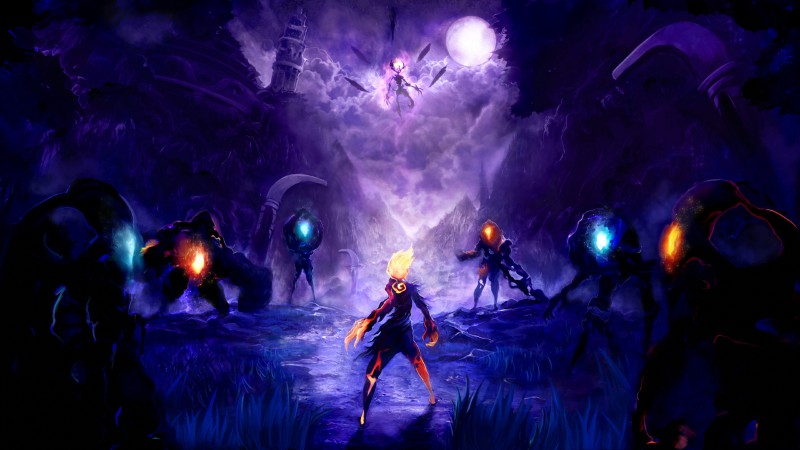
It’s rare that I learn something new in an action battle. In games that feature it, you’re likely using either guns to kill enemies or melee action to take them down, and I’m not often surprised by how this can work. I can, of course, fall in love with familiar combat despite that, but it’s always exciting to experience something I haven’t before, which is what Strayed Lights manages to do.
Relying almost exclusively on a unique parry system requiring you to switch between two colors to match your enemy’s attack, I couldn’t get enough of Strayed Lights’ action, even if it was repetitive. The fact that this action was set in an alien, beautifully realized world with a musical score by Austin Wintory made the experience even more enjoyable.

Strayed lights begins with something of a birth. You start as a spark of light – an ember – on a journey to transcendence. To succeed, you must confront your inner demons – darkness – using a defense-focused combat style, all while exploring more of this ethereal sci-fi world to learn about your existence. In my first hour, I felt overwhelmed because developer Embers does little to hold your hand or even guide you in a direction, but the game’s openness is more linear than it first appears.
The platforming can be a bit shaky. Your character will often hit the ground and then have to wait for a moment before they can stand up again. The design makes the large jumps in this game feel heavy. But platforming is rarely the star of this show as it’s more of a quick means to reach the next combat arena.
Strayed Lights will begin to glow when an enemy gets close. Pressing the left bumper will change the color of my character’s fiery lights from blue to red and back again. You should learn how to do this quickly after you start the game, because your enemies also switch colors in this way. You must parry the enemy’s color with your right bumper. This mechanic starts simple, but a third color you cannot match – purple – is thrown into the mix, requiring you to dodge. The game reaches its peak when a fourth colour is introduced and the enemies switch quickly between it as they attack you in three, four and even five strikes. My favorite part was quickly changing my color to match the enemy’s, parrying when needed, and dodging when I had to.
It was only by parrying that I could gain health when fighting, so it forced me play with more risk as my health began to drop. There are abilities and special moves you can unlock for your combat repertoire but ultimately, learning Strayed Lights’ parry mechanic is crucial – there’s no reaching the end if you can’t nail the timing. The game’s parry mechanic was very satisfying and I would recommend it to anyone who enjoys the action of melee games.

It’s fun to explore the areas and collect items that are related to lore or leveling up. The good news is that it’s not difficult to divert from your path and find the collectibles. This allows you to get back to fighting. Although the combat is straightforward, it’s satisfying. I found myself enjoying almost all of my encounters, even when I faced more than one foe at a given time.
It’s a shame that the enemies are so monotonous. Strayed Lights had only a few monsters. It was fun to learn each enemy’s attack patterns, but I wish there were more.
My eyes and ears feasted on the visual design. Each new area I opened in Strayed Lights was a visual delight. The landscapes have been painted with beautiful colors like neon pinks, purples, greens, blues, and neons. The ember lights of my characters shone against these backgrounds and I have a dozen or so screenshots to prove it. Wintory’s score matches the tone of each place, dancing between ethereal wind instruments and ritualistic percussion that seemed to be speaking its own alien language. Even when the gameplay falters, like in two-enemy combat scenarios or the game’s less-than-great platforming, I enjoyed being in this world because of Strayed Lights’ score and visual design.
Strayed Lights has a short and sweet story, but excels in what it wants players to accomplish. The unique combat system, which requires parrying, is something I’ve never seen before. It was a lot of fun, particularly in the boss fights. Its exploration doesn’t require much effort, which is a good thing because it largely doesn’t feel great to platform through areas. Its misses are easy to put aside, though, when what I’m looking at and hearing throughout the game is such a delight. Strayed Lights is a strong debut from Embers in almost every way and serves to highlight the importance of a game’s foundation. At its core, Strayed Lights revolves around a simple, intuitive, and unique combat system, and with this strong base in place, it’s no wonder the game shines as bright as it does.
#Strayed #Lights #Review #Parry #Dark