Mayors of the World Turns Running a City Into a Brilliantly Funny Political Circus
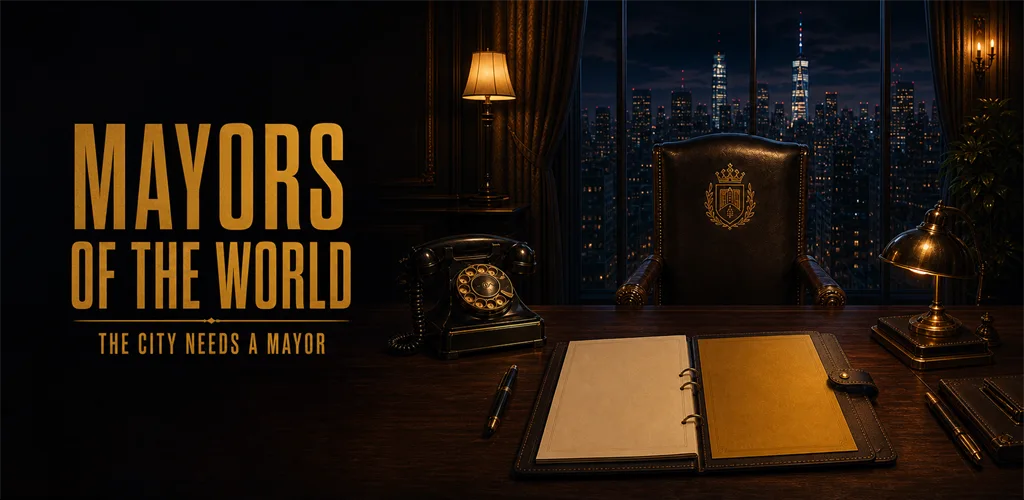
Political leadership is usually presented as serious business. Mayors of the World on Google Play takes a very different approach, inviting players to manage a city where urgent policy decisions collide with escaped animals, absurd business proposals and municipal disasters that feel just plausible enough to be worrying. More information is available on the official Mayors of the World website. The result is a decision game that can make players laugh at a ridiculous headline one moment and genuinely reconsider their priorities the next.
A City Hall Built for Comedy
The premise is simple: the city needs a mayor, and apparently nobody more qualified was available. Players inherit responsibility for public money, citizen confidence, political heat and the general condition of the city. Each scenario introduces a problem and offers several possible responses. Some choices are sensible, some are risky, and others possess the unmistakable energy of a press conference that will later become evidence.
That sense of humour is the game’s strongest immediate hook. Mayors of the World does not merely attach jokes to an ordinary management interface. It creates visual situations that are funny before a player has even read the accompanying text. A tiger can appear on a luxury Manhattan balcony. Pensioners can be sent into orbit in the name of municipal cost-cutting. A drone company may decide that a New York street filled with speed bumps is actually an aviation opportunity. The game understands that bureaucratic language becomes especially amusing when everyone involved treats complete nonsense as a legitimate policy proposal.

A billionaire’s tiger becomes an unusually complicated New York policy problem.
Crucially, the comedy does not eliminate consequence. Players still need to consider the city’s finances, its residents and the political cost of every decision. A choice that sounds compassionate may create an expensive recurring obligation. A profitable scheme may anger citizens. An efficient shortcut may solve today’s crisis while quietly preparing tomorrow’s scandal. The funniest answer is not automatically the best one, while the most responsible answer may produce an unexpectedly ridiculous outcome.
Where the World Joins the Joke
The game begins with the pressures and personality of New York City, but its Global Mayor material rapidly widens the map. Players can encounter Buenos Aires, Sydney, Corfu, Palma de Mallorca, Rio de Janeiro and Athens, before the political phone starts ringing from Cape Town, Istanbul, Porto, Alicante and Bangkok. The result feels less like leaving one city behind and more like running an increasingly unmanageable international mayors’ group chat.
The journeys continue through Tokyo, Dubai, Mumbai, New Delhi, Kuala Lumpur, Seoul and Singapore, with further situations connected to Florianópolis, Vitória, Vigan, Lagos, Mexico City, Amsterdam, Rome and Paris. Famous skylines and landmarks are not used merely as scenery. They become stages for strategic questions involving tourism revenue, taxation, clean air, public transport, ageing populations, family policy, investment and environmental restoration.
That global structure gives the satire room to change character. A mayor may be asked to help clean the water around Puerto Madero in Buenos Aires, consider the future of the Sydney Opera House precinct, support historic restoration in Corfu or rethink the waterfront in Rio de Janeiro. Athens can raise questions about pollution around the Acropolis, while Cape Town, Istanbul, Porto, Alicante and Bangkok generate their own mixtures of beauty, ambition and civic absurdity.
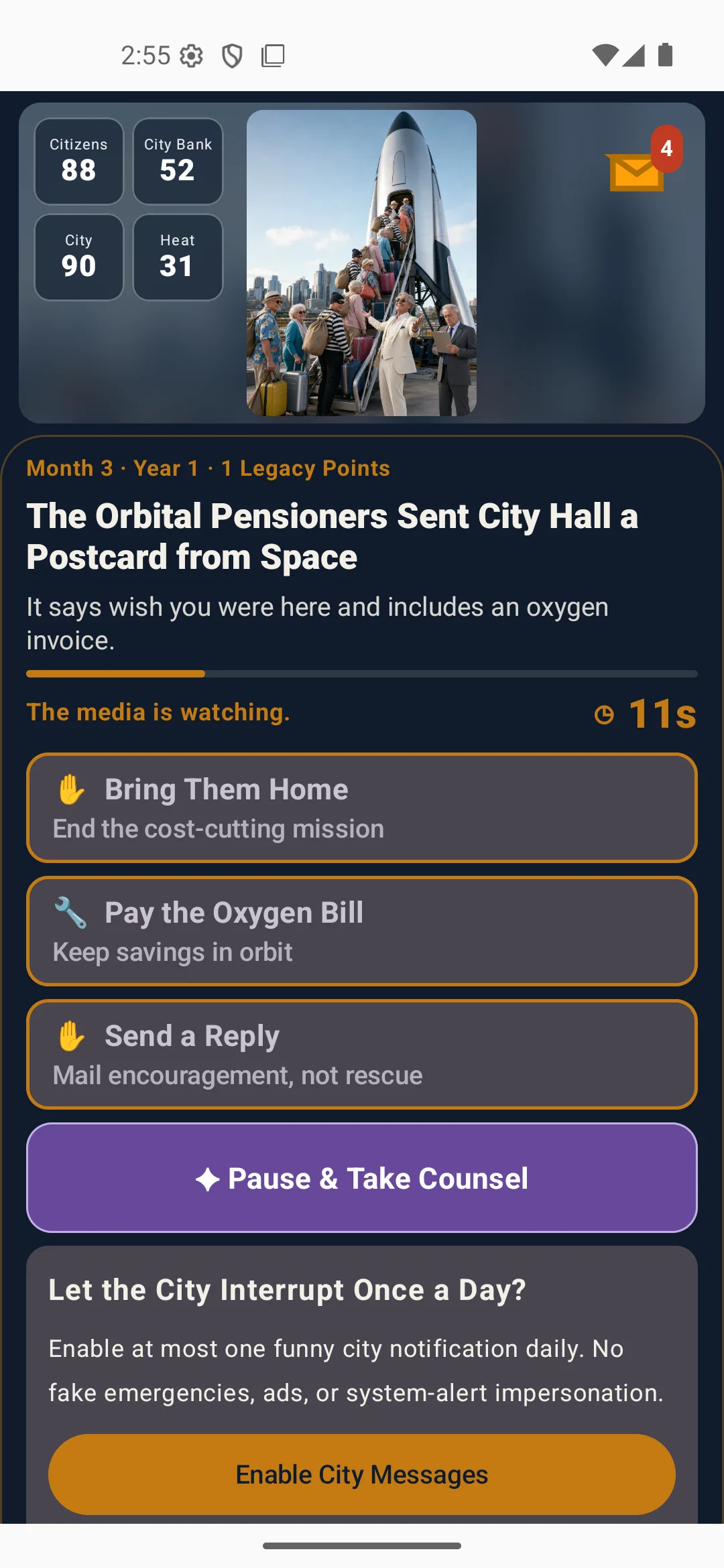
A typical crisis asks the player to balance city statistics, time pressure and three competing responses.
Decisions That Remember You
The design avoids treating decisions as isolated quizzes. The player is building an administration with a history. Earlier choices can influence later events, and the Mayor’s Inbox gives the city a memory. Messages, reactions and delayed consequences help turn individual scenes into an ongoing relationship between the player and the world. The inbox can offer advice, deliver personal commentary or remind the mayor that a decision which appeared finished has developed another chapter.
The decision screen keeps pressure visible. Citizens, the City Bank, overall city condition and political Heat sit above the current crisis, while a countdown discourages endless deliberation. Three responses compete for attention, and players who want another perspective can pause to take counsel from the Cabinet. The presentation makes each choice feel like an official act rather than a casual menu selection—even when the official act concerns a tiger, a space invoice or a spectacularly misguided piece of infrastructure.
A Political Game With Shareable Personality
Mayors of the World is especially effective when it moves between emotional tones. A ridiculous incident can be followed by a meaningful civic project, an ethical compromise or an unexpectedly sincere message. That rhythm prevents the humour from becoming shallow and stops the serious material from feeling like homework. Players are encouraged to laugh, make a quick decision and then wonder whether they have accidentally become the kind of mayor they would complain about in real life.
Its scenes also have natural social appeal. The images are built around immediately understandable visual jokes: escaped wildlife, overconfident technology, absurd infrastructure and ambitious leaders solving problems that possibly did not exist. A screenshot can work as a punchline, but the best scenarios also invite debate. Friends can disagree about what the mayor should have done, turning a solitary decision into a conversation.
The game therefore succeeds as more than a political parody. It combines management, consequence, spectacle and character-driven correspondence with a willingness to be genuinely silly. It understands that leadership games become more memorable when the player is not merely optimising numbers but developing a recognisable governing personality: responsible reformer, reckless visionary, charming opportunist or exhausted administrator wondering why there is now a tiger at the budget meeting.
Players who enjoy this mixture of political choices, management pressure and delayed consequences may also want to explore Reigns, Suzerain, Tropico, Democracy 4 and Yes, Your Grace. Mayors of the World occupies its own unusually comic corner of that field, however: a place where civic ambition meets visual absurdity, the inbox is never entirely innocent, and every confident mayor is only one questionable decision away from becoming tomorrow’s headline.