Microsoft Flight Simulator Releases Local Legend 10: Boeing 307 Stratoliner
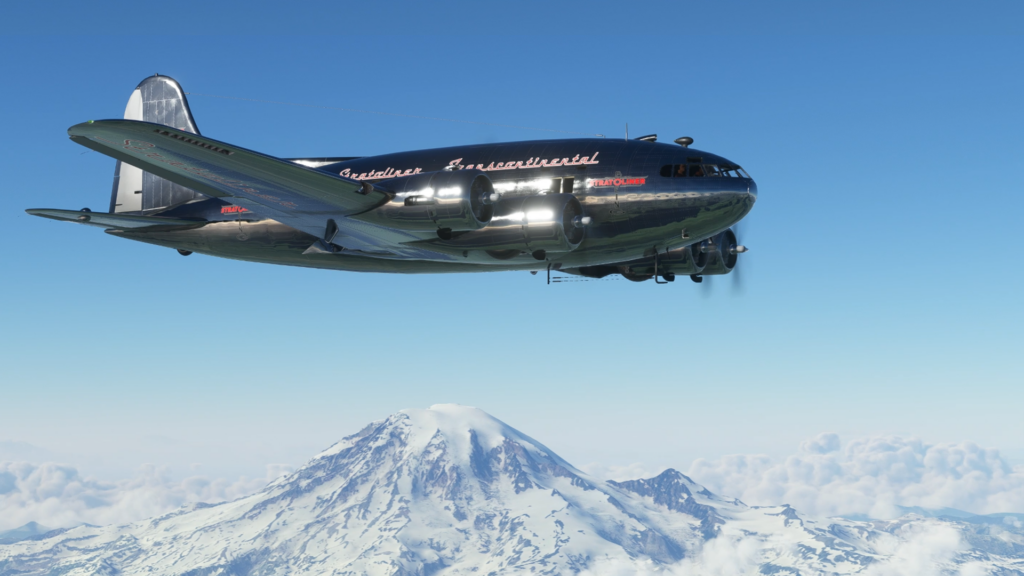
Microsoft Flight Simulator has released today the latest Local Legend in its Local Legends series, The Boeing Stratoliner 307, developed by renowned developer Airplane Heaven. Boeing stunned the world with its Stratoliner 307 in the 1930s, a glimmering monument of aviation technology. The Model 307 was a unique airliner that was born out of the Golden Age of Flight. It took years to develop and involved intense effort from Boeing engineers and designers. The four-engine, long-range aircraft was the world’s debut high-altitude airliner, the first to feature a pressurized cabin, which allowed it to operate up to 20,000 feet above sea level. It made its first flight on December 31st, 1938 and entered regular service on the 4th of July 1940. Boeing produced ten Stratoliners.
Boeing developed the 307 aircraft in mid-1930s to meet airline industry demands for an airplane that would be able to fly comfortably above Rocky Mountain passes and operate above inclement weather. Engineers based the 307 on the company’s B-17C bomber due to its aerodynamic performance, notably its long-duration flight efficiency. Specifically, Boeing adopted the bomber’s wings, engines, engine configuration, empennage, and landing gear for the design. A notable distinction from the B-17 is the fuselage. Boeing developed a circular body section with maximum diameter of approximately 138 inches for the Boeing 307 aircraft. Its circular cross-section allowed for the cabin to be pressurized, allowing it to fly at higher altitudes. The large diameter also made seating comfortable.
Built primarily with aluminum alloy, the 307 utilized stressed-skin engineering, where the metal exterior works in concert with the aircraft’s frame for strength, flexibility, and to maintain pressurization at altitude. It could accommodate up to 33 passengers, five crew members, two pilots, and the new flight engineer, who was a brand-new position at that time. The flight engineer was responsible for technical aspects of the aircraft’s operation, including cabin pressurization, power settings, and electrical components.
The 307 uses engine-driven piston pumps to maintain the cabin’s pressure. This allows it to operate at 20,000 feet over mean sea levels while maintaining an interior pressurization equivalent to 8000 feet. Named after a mix of stratosphere airliner it reflected the high-altitude nature of its operation. In addition to its comfortable, reclined seats, the spacious cabin also included sleeper berths and galleys. The Stratoliner was a luxurious travel experience, similar to ocean liner journeys. This is what airlines tried to replicate.
Howard Hughes, an American industrialist, purchased the 307 Stratoliner in order to set aviation records. He ultimately converted it into a “flying penthouse.” Pan American Airlines (Pan Am) purchased three (each designated S-307) and Trans World Airlines (TWA) purchased five (each designated SA-307B). The Pan Am aircraft used Wright Cyclone engines with single-stage superchargers, and the TWA models used Pratt & Whitney powerplants with two-stage sequential superchargers. TWA bought five aircraft that were later converted to military purposes during World War II. These airframes were operated by the United States Army Air Forces and used the C-75 designator. After being sold by airlines and government agencies, the 307 continued to operate until 1975.
Only one of the original ten Stratoliners has survived the years intact, a model originally flown by Pan Am named “Clipper Flying Cloud.” It was meticulously restored to original condition by 30 Boeing volunteers in the 1990s and flown from Seattle, Washington to Washington, D.C. where it is permanently housed at the Smithsonian’s Steven F. Udvar-Hazy Center.
Boeing 307 Stratoliner has a length of 38 feet and 7 inches, a height of 20 feet nine inches, and wing spans of 107 feet 3 inches. The aircraft is powered by Wright GR-1820G102A Cyclone radial engine that can produce 1,100 horsepower per unit and turns 3-blade constant-speed propellers. The 307 is capable of flying 1,300 nautical miles. With a service level of 23,800 foot above sea-level, it has a speed cruise of 222 mph and can reach 250 mph.
Boeing 307 Stratoliner is available in four different liveries, including Emerald Harbor (Boeing Delivery), WorldTravel (WorldTravel), and AREA(Colombian). Climb aboard, power up the systems, crank the engines, then set off into the heights in this classic – available today for $14.99. Sky is calling.
Screenshots
#Microsoft #Flight #Simulator #Releases #Local #Legend #Boeing #Stratoliner