What is Numenor in Lord of the Rings: The Rings of Power?
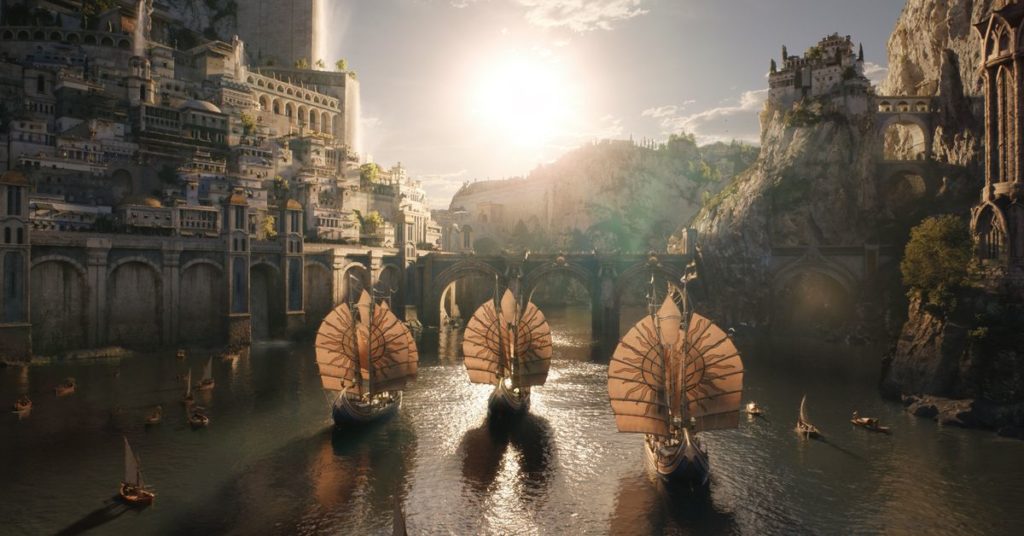
The series has been confined to two familiar Middle Earth locations for its first two episodes. The Lord of the Rings – The Rings of Power has finally shown us a place never depicted on screen before: Númenor. Indeed, much of the run time of the Prime Video series’ third episode, “Adar,” is spent on the island kingdom, which — despite its legendary status — never actually appears in either J.R.R. Tolkien’s original trilogy or the Peter Jackson movies it inspired.
That’s right: The history, culture, and geography of Númenor are all covered in The Lord of the Rings’ appendices, as well as not-so-accessible tomes published after Tolkien’s death, The Silmarillion And Unfinished Tales. Because of this, Númenor’s introduction in The Rings of Power Most likely, more casual Middle-earth enthusiasts were left scratching their heads about how the island kingdom fits into larger Middle-earth mythology.
If that’s you, this handy roundup will bring you up to speed on all things Númenórean in no time — including the kingdom’s location, origins, current ruler, and connection to The Lord of the Rings.
[Ed. note: The following covers events not yet depicted in The Rings of Power.]
Where is Númenor?
:format(webp):no_upscale()/cdn.vox-cdn.com/uploads/chorus_asset/file/15945041/5_c433f5b2cb6d4c13a7515f5d7597ca9c.jpg)
Image: Prime Video
The star-shaped island of Númenor (also known by other names, including Westernesse) is, as Galadriel notes in “Adar,” the westernmost point of Middle-earth. Tolkien refers to its location in the Sundering Seas closer to Valinor (the continent where the godlike Valar reside) than it is to Middle-earth.
It’s the logical place for Galadriel to wind up after being so close to Valinor. And it also tracks with Númenor’s seafaring culture, as their civilization was renowned for the skill of both its shipbuilders and sailors. The Númenóreans’ nautical prowess also allowed them to make numerous trips to Middle-earth prior to The Rings of Power’s setting, despite their relative distance from the continent (more on That later).
Who founded Númenor?
:format(webp):no_upscale()/cdn.vox-cdn.com/uploads/chorus_asset/file/24006332/RPAZ_S1_210602_GRAMAT_00306_R2.JPG)
Photo: Matt Grace/Prime Video
Like with so many aspects of Tolkien’s legendarium, talking about Númenor’s early days gets complicated fast. For starters, there’s the origin of the island itself, which was custom-made by the Valar for the ancient race of men who joined forces with the elves in war against Morgoth. Then, there was the mass migration of men from Middle-earth to the newly minted Númenor, which took half a century and relied heavily on assistance from the elves. Galadriel awards the credit to the elves for the existence of this kingdom. The Rings of Power episode 3, there’s a kernel of truth to what she’s saying.
That’s not where the elves’ role in Númenor’s origin story ends, either. As touched on in “Adar,” the founding king of Númenor This was an elf — albeit one with a few mortals in his family tree. Like his brother Elrond (of Rivendell fame), Númenor’s inaugural ruler, Elros, came from a mixed bloodline. Elrond eventually chose to join the Elfs, while Elros chose to stay with his manish roots. Although he was immortal, he lost his ability to live forever and was intellectually as well as physically as strong as any non-elf could be.
Elros’ descendants likewise benefited from their supercharged half-elven DNA, which explains why his descendent, Aragorn, is such an impressive specimen. But even better from an egalitarian standpoint, Númenóreans not directly related to Elros also got an overall XP boost, scoring quite a few more birthdays than their mainland counterparts. So, all in all, Elros’ decision to stick with Team Men worked out pretty well for everyone.
Who rules Númenor now?
:format(webp):no_upscale()/cdn.vox-cdn.com/uploads/chorus_asset/file/24006342/S1_EpisodicStill_RPAZ_S1_FG_00040214_Still020_R1.jpg)
Image: Prime Video
Elros’ reign lasted just over 400 years, which is why he’s no longer on the scene in The Lord of the Rings: The Rings of Power. Twenty-four monarchs sat on the throne of Númenor between Elros’ death and the events of the show, although this is one area where the adaptation begins to take major liberties with the canon established by Tolkien.
In “Adar,” the rightful king of Númenor — unnamed in the episode, but presumably Tar-Palantir based on the books — currently lives in exile atop a tower, having been deposed by his own people. Meanwhile, his daughter Míriel (Cynthia Addai-Robinson) rules in his stead as queen regent, aided by her influential advisor Pharazôn (Trystan Gravelle). This material was invented by The Rings of Power showrunners J.D. Payne, Patrick McKay, and their writers.
Tolkien says that Tar-Palantir passed away from old age. No one, not even his family, ever forced him off the throne. There’s also very little in Tolkien’s writings to suggest that Tar-Míriel (to use her regnal name) was in cahoots with the treacherous Pharazôn (her cousin in the books), especially considering he forced her to marry him to usurp the throne. Of course, there’s a chance that Míriel is only pretending to cozy up to Pharazôn in the show, but for now, that whole subplot is veering very off-book.
That isn’t to say The Rings of Power has completely abandoned its source material where Númenórean royalty is concerned. If nothing else, episode 3’s characterization of Tar-Palantir as someone still faithful to the Valar and sympathetic to the elves is bang on the money. It’s also quite clear that Payne and McKay are laying the groundwork for Pharazôn to make a play for the throne just like he does in the books at some point in the show’s planned five-season run.
And in a broader sense, the way “Adar” portrays Númenórean society (including those among its upper echelons) as growing increasingly resentful toward the elves and the Valar broadly tracks with Tolkien’s own history. Similarly, Elendil’s depiction as a high-born lord who bucks this trend is also true to Tolkien.
Where is Númenor in the Lord of the Rings series?
:format(webp):no_upscale()/cdn.vox-cdn.com/uploads/chorus_asset/file/23983682/RPAZ_S1_FG_00121011_Still097_R1.jpg)
Image: Prime Video
So, how come we don’t visit Númenor in The Lord of the Rings? Simply put, it fell. Tolkien saw the island kingdom as the Middle-earth analog of Atlantis, which is why — as recounted in The Silmarillion section entitled Akallabêth — it winds up on the ocean floor. What’s more, as in the original Atlantis legend, the cause of Númenor’s downfall ultimately boils down to two words: divine retribution.
After Pharazôn (now going by “Ar-Pharazôn”) defeats Sauron’s army and takes him hostage, the dark lord wastes no time converting him and most of the kingdom into wicked Morgoth worshippers. Eventually, Sauron manages to convince Ar-Pharazôn and his followers that they too could become immortal if they went to war with the Valar and conquered Valinor. Unsurprisingly, this turns out to be bad advice, and after the Valar call on Eru Ilúvatar (the supreme being of Tolkien’s cosmology) things Really escalate. Eru Ilúvatar wipes out the Númenórean fleet along with the entire kingdom, in a cataclysmic event of literally world-changing proportions (we’re talking moving from flat earth to round earth here).
The few Númenóreans who survived Eru Ilúvatar’s judgment were largely those who stayed true to the old ways. Led by Elendil and his sons Isildur and Anárion (unlike in The Rings of Power, he doesn’t have a daughter too) they made their way to Middle-earth’s shores and founded the kingdoms of Arnor and Gondor — the latter of which plays a major role in The Lord of the Rings.
#Numenor #Lord #Rings #Rings #Power